


German engineering sentiment improves but remains shaky
The mood in Germany’s mechanical and plant engineering sector improved somewhat at the start of 2025 but remains very mixed, according to the latest survey by association VDMA conducted in late March.
Just over a quarter (27%) of the total of 940 companies now rate the current situation as very good or good, compared with 22% in January, Kallanish hears. By contrast, 30% rate the situation as poor or very poor. The outlook has also brightened somewhat: almost one in three companies expect the situation to improve in the next six months, versus only 22% in January.
However, “this may only be a snapshot”, cautions VDMA chief economist Ralph Wiechers. The survey was completed before 3 April, so the latest tariff announcements by the USA and the reaction of the countries affected are not yet reflected in the results.
As a positive factor, the drop in interest rates should also have a favourable impact on the industry. In addition, the industry will also be able to benefit from Germany’s €500 billion special fund for infrastructure investments – if bureaucracy and long approval procedures do not slow down the investment climate.
North America, as the most important overseas market, has lost ground. In January, 42% of companies rated sales opportunities in North America as good or very good. But, with a view to the next six months, North America received only 29% of responses in March.
Germany, on the other hand, was able to catch up considerably. Almost one third of companies expect a positive domestic business trend, versus only 13% in January.


German rebar prices climb further
Germany’s rebar mills have given their prices another push in April, which appears to have been accepted in the market, Kallanish notes.
Attempts to bring up base prices over recent months received limited success, not reaching the €400/tonne ($455) target until March. That mark has now been passed, owing probably to the prolonged shutdown of the liquid phase at Riva Hennigsdorf.
The mill near Berlin stopped steel production at the end of December and introduced short working hours for its staff. Production was not restarted at the end of March as originally planned, with the suspension continuing until further notice.
Buyers currently see the base price at €420/t. Adding the fixed size extra of €265, the delivered price would be at €685/t.
“With Henningsdorf out, two of the other producers were able to assert higher prices, and I believe prices are trending up further,” one manager tells Kallanish. Paradoxically, the trend could also be stopped by Riva’s German subsidiary as soon as it decides to rejoin the improved market and restart production, the manager adds.

Deutsche Bahn hesitates over low-emission rail sourcing
Deutsche Bahn (DB) has been slow with its offtake of low-emission steel rail or even to buy any notable tonnages so far. Germany is lagging behind other European countries such as France, Austria, Belgium in terms of sustainable steel procurement for transport infrastructure, says Saarstal Acoval and Saarstahl Rail chief executive Nadine Artelt.
The latter unit of German steelmaker Saarstahl secured in February a significant contract valued at €1 billion ($1.1 billion) to supply railway operator SNCF with low-emission rail over six years.
A similar deal with Deutsche Bahn is not within sight, Kallanish heard from Artelt during a discussion panel at the Zukunft Stahl conference in Essen in March. Deutsche Bahn has an “enormous demand” for rails that she says is similar to that of SNCF, between 180,000-200,000 tonnes/year. “Still, starting talks was much easier in France and Austria,” she noted.
DB’s head of sustainability, Max-Christian Lange, conceded during the discussion that DB has not made the decisive move forward in this respect, despite its defined target to become climate neutral by 2040.
DB tenders for suppliers are preceded by discussions with its main owner, the German state. Lange alluded that talks at this level proceed sluggishly. With a view to sourcing CO2-reduced steels, therefore, “at the moment we at DB are still only in a position of a future supporter of the cause.”
Saarstahl Rail has an annual output of 400,000 tonnes of steel producing a variety of rail profiles, including vignoles, switches, grooved rails and rail tracks.

Rheinmetall may use Volkswagen plant to produce tanks
German military giant Rheinmetall is considering taking over one of Volkswagen’s soon-to-be-unused plants, as the arms maker seeks additional production capacity in Germany while domestic carmakers struggle, Kallanish notes.
According to the company’s chief executive, Armin Paperge, VW’s Osnabrück plant is “suitable” for Rheinmetall’s operations, but stressed that any decision to acquire unused car plants would depend on securing more tank orders. “It is much more complicated to build something than to use something that is already there. We are in constant conversation with VW over the automaker’s military truck joint venture with MAN Truck & Bus,” he said during his company’s annual press conference last week.
“An era of rearmament has begun in Europe and for Rheinmetall it brings growth prospects in the coming years that we have never had before,” Paperge noted.
The Düsseldorf-based company reported a 30% on-year increase in its defence business last year, driving total sales to $10.6 billion.
Rheinmetall said that about 30% of its sales went to Germany’s armed forces – a figure likely to rise if incoming Chancellor Friedrich Merz succeeds in his plan to bypass the country’s strict debt rules to allow unlimited borrowing for defence spending.
The company expects sales to increase by up to 30% this year, adding that this would also “improve operating profit”.
Rheinmetall has been one of the biggest beneficiaries of Russia’s invasion of Ukraine as investors put aside ethical concerns about arms stockpiles. The company’s share price has risen more than ten-fold since the war began in 2022.
VW’s Osnabrück plant is one of three that will remain unused for the next two years after the automaker decided last December to halve its production capacity in the country due to slowing car sales in Europe.
Svetoslav Abrossimov Bulgaria
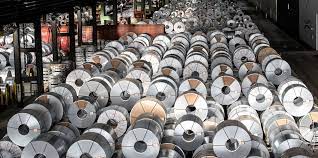
Fire at Salzgitter’s hot rolling mill interrupts flat steel production, deliveries
The fire occurred at the hot-rolling mill at Salzgitter Flachstahl in southeast Lower Saxony, Germany on February 28, the company said in the letter.
The cause of the incident was not disclosed.
“Due to damage and consequently the necessary emergency reparations, production in our hot-strip mill is currently disrupted,” the letter reads.
“Since our integrated steel mill doesn’t have additional hot-strip mills, the production plants that follow the hot-strip mill within our production process will presumable not able to produce with full capacity until the necessary reparations are complected,” it continues.
The company said it hopes to resume operations “as soon as possible,” but did not specify a timeline.
Salzgitter’s spokesperson did not reply to Fastmarkets’ request for comment before the time of publication.
Salzgitter Flachstahl, located in the city of Salzgitter is the company’s major steelmaking asset in Germany, comprising three blast furnaces with a combined capacity of more than 4 million tonnes per year of pig iron. The Flachstahl facility produces about 3.5 million tpy of hot-rolled coil, 1.8 million tpy of cold-rolled coil and 1.4 million tpy of coated flat steel, according to Fastmarkets data.
Expected supply tightness bullish for prices
Market sources told Fastmarkets that the incident at Salzgitter, as well as limited imports amid a steel safeguards review could support domestic flat steel prices up further in Germany.
Fastmarkets calculated its daily steel hot-rolled coil index, domestic, exw Northern Europe at €629.04 ($662.47) per tonne on Tuesday, up by €1.12 per tonne from €627.92 per tonne on the previous day.
The Northern European index was up by €8.41 per tonne week on week and by €35.29 per tonne month on month
Official offers were reported at €640-660 per tonne delivered (€630-650 per tonne EXW) in Germany, with a transaction heard done at €630 per tonne EXW earlier this week.
Downstream products prices – CRC and HDG – has already started reacting on news about supply disruption.
According to industry sources, the tradeable market price for both CRC and HDG in Germany this week was close to €740-750 per tonne delivered, which would net back to €730-740 per tonne ex-works.
The official offers of the German mills for mid-May/June delivery CRC and HDG were heard at €750-760 per tonne delivered, which equals €740-750 per tonne ex-works.
By comparison, Fastmarkets’ weekly assessment for steel cold-rolled coil domestic, exw Northern Europe stood at €690-710 per tonne ex-works on February 26, two days before the incident.
And Fastmarkets’ weekly price assessment for steel hot-dipped galvanized coil domestic, exw Northern Europe was at €710-735 per tonne ex-works on February 26.


Grey skies over Germany have silver lining
Despite the continued weakness of the overall European steel industry, Germany can point to some feats that are largely overlooked, says consultant Andreas Schneider. He finds steel industry representatives have been painting a gloomier picture than necessary.
In a five-year comparison, with the pre-Covid year of 2019, German steel production has declined by 8.5%. But some major customer industries – automotive, mechanical engineering, and structural construction – have dropped by two-digit percentages, Schneider notes. General construction is the one sector that hardy declined at all during that period.
In terms of apparent consumption – a measure used by worldsteel – Germany fared better last year than was assessed by the association. In October, worldsteel forecast a year-on-year drop by 7% in apparent demand for the year, but Schneider claims that things ultimately ended on a better note, meaning the drop might not have been more than 1%. He attributes his assumption to stabilising inventories and imports declining by more than expected.
For external trade in general, “the figures hold some truly surprising findings and shed a good light on German performance,” Schneider tells Kallanish. Although the December figures are not yet available, it is obvious that the result for 2024 will be the best since at least 2008, he points out.
In 2023 as well as in 2024, the German steel industry achieved a trade surplus, with a growing trend. While 2017 and 2018 saw deficits of 4 million tonnes, respectively, 2023 ended with a trade surplus of 1mt, and 2024 with more than 2mt.
Steelmakers are benefitting from duties on steel imports, which is a protection most steel-using industries do not enjoy for their products, Schneider points out. Apart from that, it is an advantage for German mills that 80% of their exports stay within the EU.
Christian Koehl Germany

German monthly steel sales rebound from Dec slump
Monthly German steel sales reached 814,862 mt in January, down 0.9% year over year but rebounding 76.3% month over month, data from the German steel stockholders’ association BDS showed Feb. 21.
The month-over-month gain was fuelled primarily by sales of the flat steel product category which increased 80.8% from December to 508,120 mt. Despite the monthly bounce, flat steel sales were 5.1% lower year over year.
Monthly sales of long products were reported at 228,249, up 67.6% monthly and 11.9% year over year.
Other products followed a similar trajectory, increasing 76.3% monthly and 14% year over year to 78,493 mt.
Market participants surveyed by Platts point toward recent news surrounding US tariffs, and upcoming elections in Germany as increasingly bullish factors in the market. Some sources also cited stable fundamentals, arguing that demand drivers have not shifted significantly in recent weeks.
Platts assessed the Northwest European domestic HRC price at Eur605/mt ex-works Ruhr, Feb. 20, stable day over day and up Eur5/mt week over week.
Meanwhile, German steel product stocks totaled 1.895 million mt in January, rising 6.4% year over year and down 0.6% from December.
Flat products made up 63.8% of the total inventories in January at 1.209 million mt, which was 1.1% lower year over year but 8.8% higher month over month.
Long products stocks totaled 651,346 mt in January, or 34.4% of the total inventory, increasing 0.8% year over year and 2% from December.


German rebar mills try to increase prices again
German rebar mills tried to increase offers over previous contracts last week, with the modest rise seen as more realistic than those announced in December.
The base price would now be at €380/tonne ($398/t), which plus the standardised size extra of €265/t brings the delivered price to €645/t.
“The mills did not succeed with their wish to push up prices in the new year, so now this is a new run-up,” one buyer tells Kallanish. In combination with elevated prices for scrap and electricity, he thinks it highly probable the mills will prevail. “We might soon see €650/t delivered,” he says.
Others do not see a new price level coming soon and have not heard of higher prices, given the low level of inquiries and orders. One manager says the latest offers he saw last week still put rebar at €360/t and wire mesh at €460/t.
For rebar, the delivered price would be at around €625/t, which other sources consider realistic for recent transactions.
By December, many customers had placed orders for replenishment at base prices well below €350/t, leading to full order books that encouraged mills to target €400/t. This level was however never attained.
The current hike is more likely to succeed, or at least to stabilise prices. One analyst says he sees prices moving only sideways until April.
Christian Koehl Germany

Sülzle Stahlpartner launches carbon-reduced rebar brand
German rebar distribution and bending group Sülzle Stahlpartner has introduced a carbon-reduced product line named STOOX PCF Steel, validated by auditing organisation TÜV.
According to a company spokesman, the move follows increasing inquiries from construction projects, especially in the public sector. Stoox will already be used in an ongoing project, the construction of the U5 underground train line in Hamburg, to which Sülzle is delivering pre-fabricated, custom-made reinforcement cages.
Sülzle claims that Stoox has an average carbon footprint of less than 400kg CO2 equivalent per tonne, undercutting the original target of 500kg CO2e/tonne, as is requested by the awarding authority.
Sülzle appears to be the first German distributor of rebar to announce such a label. It became a member of the Responsible Steel movement one year ago. “We are certainly the first company to have the entire process for determining the product carbon footprint backed by a TÜV certification,” the spokesman tells Kallanish.
Sülzle receives its rebar from various mills that document the carbon footprint of their production; the TÜV certificate also covers the subsequent logistics and fabrication, the spokesman explains.
Hamburg’s ARGE U5 project, a joint venture between Ed. Züblin AG and Wayss & Freytag Ingenieurbau AG, is meant to be a lighthouse project for environmentally sound construction. It aims to reduce conventional CO2 emissions during the U5 construction by 70%.
Christian Koehl Germany

German car production seen rising slightly in 2025
Germany’s carmakers expect only a slight year-on-year increase in domestic passenger car production in 2025 – by 1% over 2024 – to 4.15 million units, Kallanish hears from national automotive association VDA.
The main reason for this is overall economic weakness, VDA notes. Foreign production of German brands is expected to increase by 2% to 9.7m cars globally.
With regard to electric cars, however, “we expect a positive development, after a production record was already reached last year,” says VDA chief economist Manuel Kallweit.
VDA forecasts domestic production of electric cars to increase by 24% in 2025, with battery-driven cars rising by 30%, and plug-in-hybrid cars by 2%. Overall, 1.7m electric cars are likely to be manufactured in Germany this year. The country will thus consolidate its position as the world’s second-largest production location for electric cars behind China, VDA underlines.
German passenger car production last year came to 4.1m units, about the same as in 2023. This meant a notable slowdown in the production rebound seen over the previous two years. In 2023, output from German plants had risen 18% year-on-year. In 2022, production increased 11% on-year, recovering gradually from the shortage of semiconductors that dominated 2021. However, compared to the pre-Covid year of 2019, 2023/24 output was still 12% lower, the association notes.
Christian Koehl Germany