


European Commission approves Liberty acquisition of ArcelorMittal plants

The European Commission has given the green light for the acquisition by Liberty House of a number of ArcelorMittal’s European steelmaking assets, Kallanish learns from official company statements. As a consequence, Liberty will integrate most of its businesses in Europe, the UK and Australia under one entity.
The closing of the transaction is now expected to be done before the end of June this year. Following the closure, Liberty will become the third-largest steelmaker in Europe and one of the top ten steel producers outside China.
Liberty is set to buy a number of ArcelorMittal plants, put on the market following ArcelorMittal’s acquisition of Italy’s Ilva group. The plants include ArcelorMittal Ostrava (Czech Republic), ArcelorMittal Galati (Romania), ArcelorMittal Skopje (North Macedonia), ArcelorMittal Piombino (Italy), ArcelorMittal Dudelange (Luxembourg), hot-dip galvanizing lines 4-5 at ArcelorMittal Liège, and three lines located in Tilleur (Belgium).
In a separate transaction, Liberty is also set to purchase four flat product service centres from ArcelorMittal CLN Distribuzione Italia.
As it received the green light, Liberty also announced that it will integrate most of its steel engineering and mining business into a single entity. “The consolidated business will include all of the UK steel and engineering assets, the integrated Australian Liberty primary steelworks in Whyalla, a number of high-quality Australian iron ore and metallurgical coal mines, and, once completed, the seven European steel plants being acquired from ArcelorMittal,” Liberty says.
“This combination will form a global champion, with fully integrated capabilities, shipping iron ore and coking coal and semi-finished product from Australia to its manufacturing plants and mills globally with the target of becoming one of the largest and most competitive fully integrated steel and mining producers in the world, from raw materials to high value finished goods,” says Liberty chief Sanjeev Gupta.
Liberty produces steel and engineering components in the UK. In Australia the company is a leading producer of rail and structural steel, with plans to build a new manufacturing facility with a capacity of over 10 million tonnes/year. “The proposed European acquisition from ArcelorMittal will boost Liberty’s production capacity across a full range of flat and long products, setting the Liberty steel and mining group up for rapid growth,” the group explains.


Global steel demand growth to slow: worldsteel
An uncertain trade environment and weaker global economic activity is expected to slow steel demandgrowth in 2019 and 2020, according to the World Steel Association’s short-range outlook, released Tuesday.
Worldsteel expects demand to increase 1.3% to 1.735 billion mt in 2019, and increase by 1% in 2020 to reach 1.752 billion mt. Global steel demand increased by 2.1% in 2018.
“In 2019 and 2020, global steel demand is expected to continue to grow, but growth rates will moderate in tandem with a slowing global economy,” said Al Remeithi, chairman of the worldsteel economic committeet. “Uncertainty over the trade environment and volatility in the financial markets have not yet subsided and could pose downside risks to this forecast.”
China’s deceleration, a slowing global economy, uncertain trade policies and the political situation in many regions suggest a possible moderation in business confidence and investment, worldsteel said.
Steel demand in developed economies is expected to grow by only 0.3% in 2019 and 0.7% in 2020, reflecting a “deteriorating trade environment.” This demand grew by 1.8% in 2018, following growth of 3.1% in 2017.
In the US, construction and manufacturing growth is expected to moderate, while investment in oil and gas exploration should decrease, worldsteel said. Overall, steel demand in the NAFTA region is expected to increase 1.1% to 144.5 million mt in 2019, and 0.8% in 2020 to 145.6 million mt.
The EU is also facing uncertainty as a result of Brexit, with worldsteel expecting slower steel demandgrowth in the major EU economies in 2019, particularly for those countries that are more export-dependent. EU steel demand is projected to increase 0.3% in 2019 to 170.2 million mt, and 1.2% in 2020 to 172.2 million mt.
Steel demand from emerging economies is expected to grow by 2.9% and 4.6% in 2019 and 2020, respectively, worldsteel said.
India is expected to experience faster growth in the second half, worldsteel noted, with infrastructure development supporting demand in the ASEAN region. Steel demand in developing Asia, excluding China, is expected to grow by 6.5% and 6.4% in 2019 and 2020, respectively.
— Justine Coyne
Italian car production lowered
Italian car output lowered in February again after having also fallen in January. The trend in production seen in February is continuing the fall seen in 2018, Kallanish learns from local carmakers’ association Associazione Nazionale Filiera Industria Automobilistica (Anfia).
According to preliminary data, passenger car production decreased in February by a significant -11% compared to February 2018. Overall in first two months of the year production fell by -18% year-on-year.
Although no numbers have been disclosed by Anfia, Italian car output in January 2018 was 50,000 units and 60,000 units in February 2018. Kallanish calculates that February 2019 output would therefore have been around 53,400 units.
Car production in Italy slowed significantly in 2018 by -10% year-on-year to 671,000 units. The country’s total production of vehicles including heavy transport was 1.06 million units, down by -7% y-o-y.
February 2019: Spain & Italy main CRC export destinations from Turkey
Turkish mills’ CRC export volumes, which sharply increased year on year in the first month of 2019 to 85,780 mt with the support of strong sales to Europe, particularly Italy, fell notably in the second month of the year to 34,230 mt. This export figure was, however, still higher than the 21,820 mt exported in the same month the previous year.
According to the latest Turkish Statistical Institute (TUIK) data sent to S&P Global Platts, Spain became Turkey’s main CRC export destination in February at 11,600 mt, while Italy was second at 9,280 mt, down from 50,000 mt the previous month. Turkey’s CRC exports to these two EU countries constituted 61% of its total CRC exports in February.
Turkish mills, however, shipped no CRC cargoes in February to what had been one of its main export markets, the US, for the sixth consecutive month, amid the doubling of US Section 232 tariffs against Turkish steel in mid-August of last year.
Despite the tariffs, the US remained Turkey’s main export CRC market last year at 144,150 mt, as reported.
Turkish mills also exported 2,300 mt of CRC to Portugal in February, while exports to Iraq also totaled 2,300 mt, the latest data showed.
Turkish mills’ domestic and export CRC prices, meanwhile have begun to soften in recent days, in line with mills’ HRC pricing, due to slowed demand both in the domestic and export markets.
Turkish mills’ CRC offers to the domestic market were generally in the range of $590-$610/mt ex-works Monday, depending upon tonnage and origin, while mill export offers were around the same range, both $20/mt lower than the beginning of the month.
— Cenk Can
Liberty to revamp pickling line at Piombino, unions
After Liberty House takes over Italian plant La Magona in Piombino, the pickling line that has been idled for a number of years will be revamped and restarted, a union source tells Kallanish. This follows a meeting in Piombino between unions and Liberty ceo Jon Bolton.
Restarting the pickling line will also mean hiring around 30 workers. The new owner also intends to purchase an area that will stock hot rolled coil sourced by Liberty from the market and from ArcelorMittal to feed Piombino’s mills. Further investments for the plant will be discussed during the first quarter of ownership by Liberty house, Kallanish is told.
This happens amid “…concerns regarding the financial relaunch of the plant which is not profitable,” the source says. “We are also demanding clarity on the supply contracts and prices for the hot rolled coils that Liberty is rumoured to be in the process of agreeing with ArcelorMittal to feed Piombino, but we have no precise information yet. The closing should happen by the end of May or beginning of June.”
Liberty is looking to buy a number of plants controlled by ArcelorMittal, put on the market following the acquisition of Italian group Ilva. The plants include ArcelorMittal Ostrava (Czech Republic), ArcelorMittal Galati (Romania), ArcelorMittal Skopje (North Macedonia), ArcelorMittal Piombino (Italy), and ArcelorMittal Dudelange (Luxembourg). Also included are the HDG lines 4-5 of ArcelorMittal Liège and three lines located in Tilleur (Belgium). Giovanni Carpino will be the new ceo in Piombino, the source says.
Spanish unions fret over possible tk Galmed sale
Spanish trade unions have voiced concern over the possible sale of the thyssenkrupp-controlled galvanising plant at Galmed, in Sagunto, as part of the merger with Tata Steel Europe, Kallanish learns from local sources.
The union notes that the plant could well attract the interest of a number of companies within the sector. It says Salzgitter could be among the interested parties, as the company’s ceo recently confirmed they will monitor the situation of the assets to be divested by thyssenkrupp.
Galmed was sold by Arbed-Aceralia-Usinor to thyssenkrupp in 2003 as part of the merger process that created ArcelorMittal.
The EU authorities have until the beginning of June to rule on the divestment proposal from thyssenkrupp and Tata Steel Europe as part of the merger of their operations.
European Commission receives go-ahead for US trade talks
The European Commission has been officially given the green light by EU member states to start new trade talks with the US aimed at eliminating tariffs on industrial products, Kallanish learns from an official statement.
The EC requested the approval of this mandate at the beginning of 2019, following the meeting in July 2018 between President Trump and Jean-Claude Juncker.
“The European Union is delivering on what President Trump and I have agreed on 25 July 2018,” Juncker, comments. “We want a win-win situation on trade, beneficial for both the EU and the U.S. Notably, we want to slash tariffs on industrial products as this could lead to an additional increase in EU and U.S. exports worth around €26 billion. The European Union and the United States have one of the most important economic relationships in the world. We want to further strengthen trade between us based on the positive spirit of last July.”
The initiation of the process to negotiate a new trade agreement has already effectively negated Trump’s threat of barriers on imports of cars and automotive parts. Nevertheless, many points still need be assessed, including the existing tariffs on imports in the US of steel and aluminium products from the EU.
“This is a welcome decision that will help ease trade tensions,” comments EU trade commissioner Cecilia Malmstroem. “We are now ready to start formal talks for these two targeted agreements that will bring tangible benefits for people and economies on both sides of the Atlantic. I am convinced that breaking down barriers to trade between us can be win-win.”
While giving the green light for the trade talks to start, major countries such as France voiced their opposition to the move, as this came less than two months before the election of a new European Parliament.
Insight: EU HDG quotas filling but prices still pressured
Despite import quotas for hot-dip galvanized steel sheet imports filling up this past week, prices remain under pressure in line with broader weakness in the flat steel market.
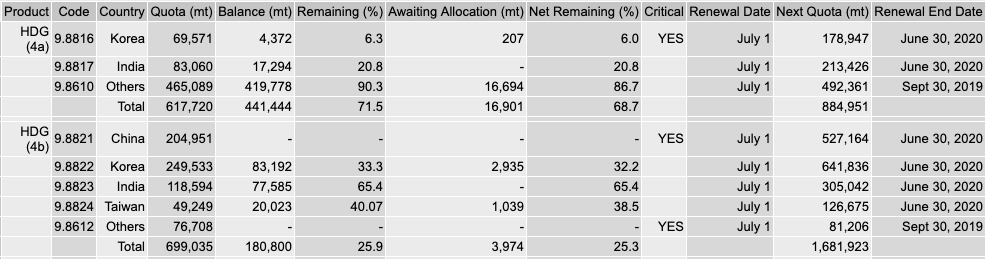
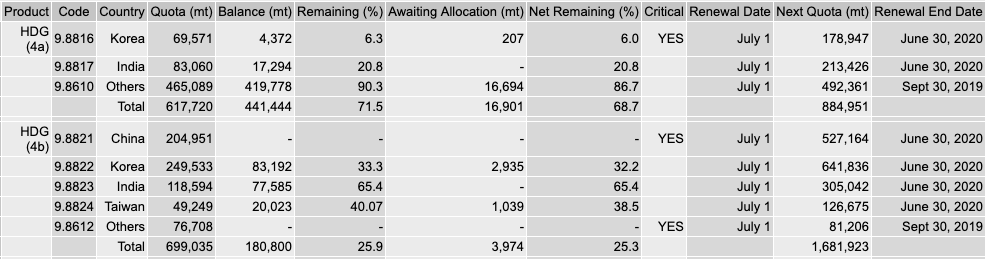
In product category 4a (HDG products mostly used in construction and industrial applications) the quota for Korean material — product code 09.8816 — has reduced to critical status of just 6.3% or 4,371 mt. Including material pending allocation and clearance into free circulation of 207 mt, this reduces further to just 6.0%, or 4,175 mt of the original 69,571 mt quota.
When a quota reaches critical status, importers are asked to deposit in advance the 25% tariff with customs authorities before importing quota-targeted products.
This raises financing costs and may deter importers and encourage warehousing or stockpiling of un-cleared material at ports while importers await quota renewal.
Once this remaining 6% balance is filled, which at the current rate of importation of approximately 590 mt/day on average in April is, likely to be within the next seven days, Korean imports can be cleared under the “other countries” quota.
European Commission rules state that when a named country has exhausted its own import quota in the third quarter of a quota year, then that named country may import material under the other countries quota in the fourth quarter of the same year provided there is a balance available.
The 4a other countries quota renewed on April 1 and still has a large available balance of just under 420,000 mt.
In product category 4b – galvanized products mostly used in Automotive applications, the initial quota of 204,951 mt for China was filled back on March 6 and will not renew until July 1.
The 4b other countries quota, having been filled in just three days in early February renewed on April 1 and allowed for 76,707 mt of additional imports.
The backlog of HDG material was sufficient to fill this renewal quota by April 4 and sources said that this was comprised of a mixture of origins with Turkish and Chinese material featuring heavily.
Traders have told Platts that they now believe large uncleared balances already exist at European ports, with 4b HDG being warehoused on an uncleared basis pending the next quota renewal on July 1.
“The galvanized quotas are full and yet prices aren’t higher … there are large balances of material waiting the next quotas already at ports, maybe 200,000 up to 500,000 mt,” a UK trader told Platts this week.
Despite the apparent aggressive subscription of the HDG quotas, especially in 4b for automotive uses, prices however remain under pressure.
One German distributor told Platts “prices in galv are lower despite quotas being filled, this is a crazy situation as the mills were all expecting higher prices with the quotas being done.” The source added further that automotive clients were taking less than their agreed “call-off amounts” each month and so the mills were having to cut prices to move material into the spot market.
Commenting on the quota situation a western European mill source told Platts “Its just a matter of time for prices to move higher” adding that he saw tradable value at Eur610/mt ex-works Ruhr with lead times from domestic production holding steady at seven weeks.
A European mill source said that he saw tradable value in HDG lower at Eur590/mt ex-works Ruhr adding “the automotive business is broken … I see the spread of HDG over hot-rolled coils reducing from current levels of Eur100/mt to around Eur80/mt in the coming months.”
The historical spread of HDG/HRC can be viewed as a barometer of automotive demand versus general commodity grade steel demand. In 2018 this trended lower over the course of the calendar year, from Eur128/mt in early January to Eur88.5/mt in November, reaching the lows during the peak of the WLTP testing issues that blighted European car manufacturers.
In 2019 the spread has traded between Eur89/mt and Eur104/mt and was last seen at Eur100.40/mt on April 12.
A German service center source said that they were seeing some automotive buying but only from customers who had cut back volumes in the third and fourth quarters of 2018. “Those guys are now seeing less metal in their supply chains and are now back buying to top up the chain, which is indeed real business, but overall significant volumes are still missing [from order books],” he said.
The source added that they saw tradable value at Eur595-600/mt ex-works Ruhr.
A central European mill source said he saw tradable value lower at Eur580/mt ex-works Ruhr adding, “the galv market is a disaster, construction demand is OK but automotive is terrible. There is so much metal around it is very easy to buy”
The Platts TSI North European HDG Coil/N.Europe domestic Ex-Works, weekly assessment base price for DX51D gained Eur2/mt to settle at Eur600/mt on Friday April 12, its lowest price level since October 2017.
— Len Griffin
Eurofer sees potential for rocky road
A spokesman for Eurofer, the European Steel Association, said in an emailed statement: “It’s positive that they could agree on an extension of a certain length. That alone provides more certainty in the near term that we had previously. However, if the political process in the UK proceeds in a way which is rocky, this might well bleed through into economic uncertainty, especially if there is no sign of any deal being passed towards the end of the extension.”
The government has already announced that in the case of a no-deal Brexit, tariffs on imports of base metals, excluding aluminum, will be reduced to 0% from 1.8%. Aluminum will be cut from 6.3% to 0%, with steel and iron little changed, with tariffs falling from 0.8% to 0%. A tariff reduction would be designed to soften the blow and reduce costs for domestic importers and processors, who would not be able to take advantage in a no-deal scenario of import safeguards negotiated by the EU.
If however, a withdrawal deal is reached with the EU, the UK government has stated that it will be able to enforce safeguards on steel imports from third countries into the UK, in line with those formally introduced by the European Commission in early February in response to the US tariffs on steel import under Section 232.
However, a lawyer contacted by S&P Global Platts at the time clarified that these antidumping measures cannot be transposed to the UK in the case of a no-deal Brexit. “In case of no deal, any AD duties will have to be imposed from scratch following a formal investigation,” the lawyer said.
— Diana Kinch
Insight: UK, EU steel welcome Brextension; hope for deal
UK and European Union steel industry associations Thursday welcomed the announcement of a six-month plus delay to the UK leaving the EU, considering any increased chance of striking a withdrawal deal as positive for the sector. Nonetheless, the prolonged period of uncertainty was viewed as a potential drain on the sector’s decision-making capacity.
ISTA, the UK-based International Steel Trade Association, struck a positive note. “ISTA is pleased that the EU and UK seem in agreement about the next step regarding Brexit. However, the sooner a mutually agreed and nationally supported decision is taken, the better,” said Brian Paterson, the association’s chairman.
Confederation of British Industry President John Allan was cited in UK media as saying the extension to October 31 has met mixed reaction from businesses, as many companies have already invested funds in preparation for a no-deal scenario. Small businesses in particular are reportedly having difficulty in planning for unforeseeable circumstances amid changes in the Brexit deadline.
The European Council late Wednesday offered a flexible extension to the UK until end-October to leave the EU, replacing the previous April 12 deadline. The extension, which increases the possibility of approval of a deal governing political, trade and regulatory matters, was accepted by UK Ambassador to the EU, Sir Tim Barrow Thursday.
In response to the extension, Gareth Stace, director general of UK Steel, the trade association for UK steelmakers and downstream processors, said: “For the second time in a matter of weeks, the UK came perilously close to a cliff-edge no-deal Brexit. UK Steel is pleased that the EU has further delayed this disaster, it is now incumbent on all sides of the Brexit debate to ensure that we do not come that close again.
“Any Brexit which limits free and frictionless trade is a bad Brexit for the steel sector, and until last night we were heading for just that. The UK steel industry sends 70% of our exports to Europe, so anything less than frictionless trade would be a step in the wrong direction.”
In 2018, a total of GBP 3.5 billion ($4.6 billion) worth of iron, steel, aluminum and other base metals were imported into the UK, according to the UK Department of Trade. Of this, GBP 1.49 billion worth was iron and steel, GBP 1.4 billion worth was aluminum and aluminum products, and GBP 606.14 million was base metals and base metal products, it said.