


ArcelorMittal: Green transition faces technical and economic uncertainties
In its 2024 sustainability report, Luxembourg-headquartered steelmaker ArcelorMittal has stated that the shift towards green hydrogen-based direct reduced iron (DRI) steelmaking and carbon capture, utilization and storage (CCUS) technologies is unlikely to be economically feasible before 2030 due to technical and economic uncertainties.
“Green hydrogen is not yet a viable fuel source, natural gas-based DRI production in Europe is not competitive as an interim solution, and CCS infrastructure is still in the planning stage. The BF-BOF route remains today the dominant primary steelmaking technology due to cost, quality, and efficiency, with DRI-EAF adoption currently limited to regions with cheap electricity and natural gas,” the statement noted.
According to the report, in 2024 ArcelorMittal lowered its Scope 1 and 2 carbon emissions by 46 percent to 102 million mt, compared to 2018. The company sold high carbon footprint assets, bringing the average intensity down to 1.75 mt of carbon per mt of crude steel, compared with the worldsteel global average of 1.92 mt.
The company stated that it will continue its efforts to achieve net-zero by 2050 by investing in lower-emission technologies and infrastructure upgrades.

National security prioritises localised steel over cost: IMF
The fragmentation of the global trading system has increased the spotlight on national security concerns, which prioritise localised production of goods like steel over their cost, says the IMF.
“In a multi-polar world, where things are made may matter more than how much they cost,” IMF managing director Kristalina Georgieva said last Thursday. “The logic of national security says that a broad range of strategic goods, from computer chips to steel, must be made at home, and that this is worth paying for. Self-reliance is staging a comeback.”
“All these concerns, taken together, have now bubbled over, leaving us in a world where industry gets more attention than the service sector; where national interests tower over global concerns; and where assertive actions trigger assertive reactions,” she added.
The IMF is due to release its latest World Economic Outlook this week. This will include notable markdowns, but not recession, Georgieva noted. There will also be markups to the inflation forecasts for some countries, Kallanish notes.
Global trade tensions are “boiling over”, she continued, largely as a result of an erosion of trust in the international system and trust between countries. “Global economic integration has lifted vast numbers of people out of poverty and made the world as a whole better off. But not everyone benefitted,” she commented.
These tensions create costly uncertainty. Imported inputs feed into a broad range of domestic products, and the cost of one item can be affected by tariffs in dozens of countries. “The result? Ships at sea not knowing which port to sail to; investment decisions postponed; financial markets volatile; precautionary savings up. The longer uncertainty persists, the larger the cost,” Georgieva said.
Rising tariffs also hit growth “upfront”. Trading partners do not bear the cost of tariffs alone. Importers pay some part through lower profits, and consumers pay some part through higher prices. Moreover, protectionism erodes productivity over the long run.
In the EU, German defence and infrastructure spending will lift domestic demand, as would EU-wide policies to improve competitiveness by deepening the single market. EU fiscal easing and stronger integration would lift growth, increase resilience, and improve both internal and external balances, Georgieva concluded.
Adam Smith Poland


German sheet formers worry about business, economy
Germany’s sheet forming industry is mostly pessimistic about business this year, according to a survey by its trade association, Industrieverband Blechumformung (IBU).
For 2024, more than 70% of IBU’s member companies report a drop of revenues, whilst only one in four saw an increase, Kallanish hears.
And the outlook on business this year is not very optimistic either, say 60% of the poll participants. The typical customer base, including mechanical engineering, automotive, electrical and construction industries, remains reserved in placing orders. As a consequence, almost 60% are cutting jobs or are working short-time, says IBU director Bernhard Jacobs.
Despite this, 45% of sheet metal forming companies are still willing to invest in their activities. But one-third of them plan to spend money on locations outside Germany, IBU is told.
Jacobs therefore urges that the future government “must give entrepreneurs back confidence and planning security through clear goals and effective measures.” Sheet formers, like many other manufacturing industries, primarily ask for a reduction in bureaucracy and lower electricity costs, followed by tax cuts and infrastructural investments, he says.
Another political issue addressed at the IBU’s members meeting in March in Leipzig was the increase of the minimum wage. Companies are concerned that the gap between minimum and regular wages will be too small, so that employees of the higher-wage groups will ask for increase as well.
Christian Koehl Germany

Ironmaking decarbonisation economical only after 2030
It is “becoming increasingly clear” that transformational, low-emission ironmaking investments are only likely to be economical post-2030 and that policies to address the high capital and operational costs involved are required to make that happen, says ArcelorMittal chief executive Aditya Mittal.
What the steelmaking group can achieve by 2030 will “depend critically” on how the regulatory environment evolves this year, particularly in Europe. The EU’s Steel and Metals Action Plan “demonstrates that Europe understands the challenges the industry faces and the seriousness of the situation and is ready to tackle the structural issues required to support the future of steelmaking on the continent,” Mittal says in ArcelorMittal’s 2024 sustainability report.
The ceo hopes the plan “will be translated into swift action,” he adds in the report seen by Kallanish.
“Pending policy clarity, there is simply too much uncertainty at the moment to be able to make useful projections about how rapidly we will be able to bring down our emissions in the next five years,” Mittal continues.
The steelmaker intends to publish revised decarbonisation forecasts when the policy environment becomes more settled. In the meantime, it continues to develop all technologies that support lower emissions iron and steelmaking.
Over the next five years, its decarbonisation efforts will continue to focus on diversifying metallics supply, increasing energy efficiency, securing clean energy, and transforming steelmaking assets through continuing the shift to electric arc furnaces.
In the longer term, it expects to transition to lower emissions ironmaking and add carbon capture and storage.
All decarbonisation-related capital expenditure will be contained within the annual capex budget of $4.5-5 billion.
“The above approach should ensure that we can move swiftly when we reach the tipping point, where the confluence of policy, technology and cost will irreversibly transform the economics of steelmaking in favour of low-carbon methods,” Mittal concludes.
Adam Smith Poland
Germany’s Salzgitter to supply steel pipes for Angolan drinking water project
Germany-based steelmaker Salzgitter AG has announced that it has signed an agreement with Germany-based BNT Bau, a subsidiary of one of Portugal’s largest construction companies Casais Group, for the supply of spiral-welded large-diameter steel pipes and pipe fittings.
Accordingly, Salzgitter’s subsidiaries Salzgitter Mannesmann Grossrohr GmbH and Salzgitter Mannesmann Line Pipe GmbH will undertake the production and delivery of the pipes with diameters of 508-1,626 mm. The pipes will be used in a drinking water supply project in Angola.


Spain’s Transmesa to invest €15 million in new stainless tube line
The new production line will allow Transmesa to expand its product portfolio and complement the carbon steel tubes produced until now. Stainless tubes will be primarily used for hydrogen and methane gas engines for hybrid vehicles and railway machinery, as well as for semiconductor production facilities that use gases and fluids.
Transmesa expects its revenue to increase by 33.0 percent to €80 million with the introduction of stainless tube sales.

WTO revises global trade forecasts amid trade policy uncertainty and surge in tariffs
According to the latest Global Trade Outlook and Statistics report published by the World Trade Organization (WTO), the outlook for global trade has deteriorated sharply due to a surge in tariffs and trade policy uncertainty. The volume of world merchandise trade is expected to decline by 0.2 percent in 2025 under the current conditions, before posting a modest recovery of 2.5 percent in 2026. The new estimate for 2025 is nearly three percentage points lower than it would have been without the recent policy shifts. At the start of 2025, WTO economists expected to see continued trade expansion supported by improving macroeconomic conditions.
The WTO noted that the implementation of the currently suspended reciprocal tariffs by the US, as well as a broader spillover of trade policy uncertainty beyond US-linked trade relationships, poses the risk of an even sharper decline of 1.5 percent in the world merchandise trade volume in 2025.
According to the report, the impact of recent trade policy changes varies sharply across regions. North America now subtracts 1.7 percentage points from global merchandise trade growth in 2025, turning the overall figure negative, while Asia and Europe continue to contribute positively, with Asia’s contribution halved to 0.6 percentage points.
Meanwhile, the disruption in US-China trade is expected to trigger significant trade diversion, raising concerns among third markets about increased competition from China. Chinese merchandise exports are projected to rise by 4-9 percent across all regions outside North America as trade is redirected. At the same time, US imports from China are expected to fall sharply, creating new export opportunities for other suppliers able to fill the gap.
WTO economists expect world GDP to grow by 2.2 percent in 2025, before slightly recovering to 2.4 percent in 2026. Tariff changes are forecast to have the largest impact on the economy of North America (-1.6 percentage points), followed by Asia (-0.4 points) and South and Central America and the Caribbean (-0.2 points). Although the imposition of reciprocal tariffs would have a limited effect on the global figure, a wider spread of trade policy uncertainty could nearly double the GDP loss to 1.3 percentage points relative to the baseline.

German engineering sentiment improves but remains shaky
The mood in Germany’s mechanical and plant engineering sector improved somewhat at the start of 2025 but remains very mixed, according to the latest survey by association VDMA conducted in late March.
Just over a quarter (27%) of the total of 940 companies now rate the current situation as very good or good, compared with 22% in January, Kallanish hears. By contrast, 30% rate the situation as poor or very poor. The outlook has also brightened somewhat: almost one in three companies expect the situation to improve in the next six months, versus only 22% in January.
However, “this may only be a snapshot”, cautions VDMA chief economist Ralph Wiechers. The survey was completed before 3 April, so the latest tariff announcements by the USA and the reaction of the countries affected are not yet reflected in the results.
As a positive factor, the drop in interest rates should also have a favourable impact on the industry. In addition, the industry will also be able to benefit from Germany’s €500 billion special fund for infrastructure investments – if bureaucracy and long approval procedures do not slow down the investment climate.
North America, as the most important overseas market, has lost ground. In January, 42% of companies rated sales opportunities in North America as good or very good. But, with a view to the next six months, North America received only 29% of responses in March.
Germany, on the other hand, was able to catch up considerably. Almost one third of companies expect a positive domestic business trend, versus only 13% in January.
South European HRC price dips, liquidity slows ahead of Easter
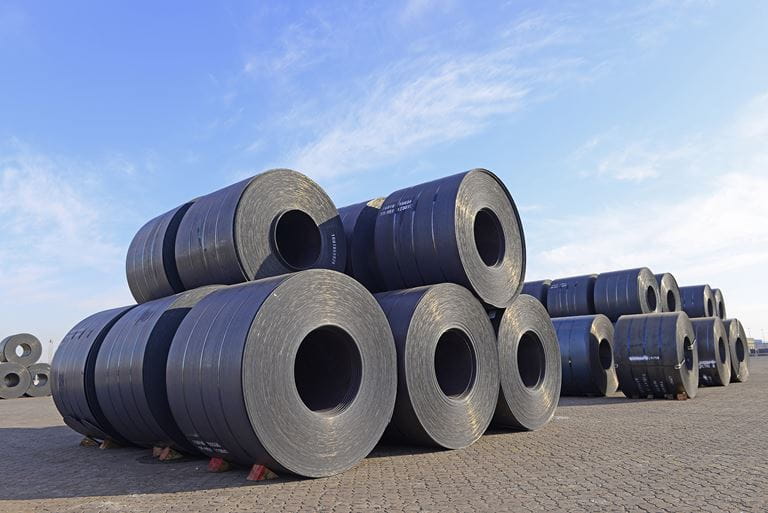
Domestic European hot rolled coil prices inched lower in South Europe April 16, amid quieter market conditions ahead of the Easter break.
Market participants pointed to ongoing uncertainty among buyers across the value chain, sharing expectations for near-term stability around the Easter break.
“There are a lot of options for commodity grade HRC but there is no demand as all the big customers are so uncertain,” a South European trader said.
“There are a lot of traders being aggressive making it difficult to make sales, but nobody is looking for larger volumes anyway,” the trader added.
A distributor pointed to similar levels of hesitancy for larger inquiries from buyers.
“Buyers remain cautious due to uncertain quota availability, ongoing market volatility and weak demand discourages bookings,” the distributor said.
“Domestic mills offer shorter lead times than imports, but some exporters are offering additional discounts from Indonesia. [However,] we see no major import offers at the Port of Antwerp,” the source added.
In addition, outlooks across Europe remained largely mixed, with sources across the market continuing to cite the ongoing trend of supply-side-driven price increases, rather than any notable change in demand-side fundamentals.
Platts assessed HRC in Northwest Europe stable at Eur650/mt EXW Ruhr on April 16, and in Southern Europe at Eur625/mt EXW Italy, down Eur5/mt day over day.
Platts assessed imported HRC in Northern Europe at Eur545/mt CIF Antwerp, stable day over day, and in Southern Europe at Eur535/mt CIF Italy.


Automotive sector woes threaten French car components producers
The French automotive sector is facing significant pressure from stringent EU environmental regulations, ambitious energy transition targets, declining competitiveness, and the US imposition of a 25% tariff on car imports.
These factors are prompting car manufacturers to explore the option of sourcing more affordable components from outside the EU, threatening domestic manufacturing.
French passenger car and light commercial vehicles (LCV) combined production decreased by 10% last year compared to 2023, says French carmakers’ association Organisation Internationale Des Constructeurs Automobiles (OICA).
The country’s automakers produced 910,243 passenger cars in 2024, reflecting a decrease of 11%. LCV output in 2024 declined 7% to 447, 458 units. Overall production stood at 1,357,701 vehicles, down from 1,505,079 in 2023.
According to local automotive component makers association FIEV, the situation in Europe and France is concerning. National production falling to 1.3 million vehicles in 2024 reflects a collapse of 63% since 2002 and 38% since 2020, FIEV president Jean-Louis Pech warned during a senate hearing last week.
More than 70% of FIEV members believe their production in France and Europe is in danger. 55% have already recognised the possibility that French and European automakers may start sourcing components from lower-cost competitors outside of Europe, according to a survey conducted in March.
In 2024, employment in the car component manufacturing sector in France decreased to approximately 56,000 jobs, reflecting a 17% decline relative to 2019 levels.
Since January 2024, approximately 7,300 jobs have been eliminated or are at risk due to restructuring initiatives or site closures. At the European level, 42% of suppliers anticipate operating at a loss in 2025, FIEV says in a document obtained by Kallanish.
The period of high inflation from 2022 to 2024 significantly widened the competitive disparity between European and Asian suppliers. Besides the US 25% car import duty, European equipment manufacturers are suffering from a general decline in vehicle production and slow offtake of electric vehicles in Europe.
The association is calling for the implementation of a baseline requirement of 75-80% of “made in Europe” content in vehicles. It is also seeking solid European measures to enhance the competitiveness of the automotive sector, especially amid the shift towards electric vehicles.
This can be achieved by executing a European investment strategy modelled after the American IRA. This includes measures such as lowering energy costs, decreasing mandatory salary deductions and production taxes in France, and simplifying access to financing, particularly for small and medium-sized enterprises.