

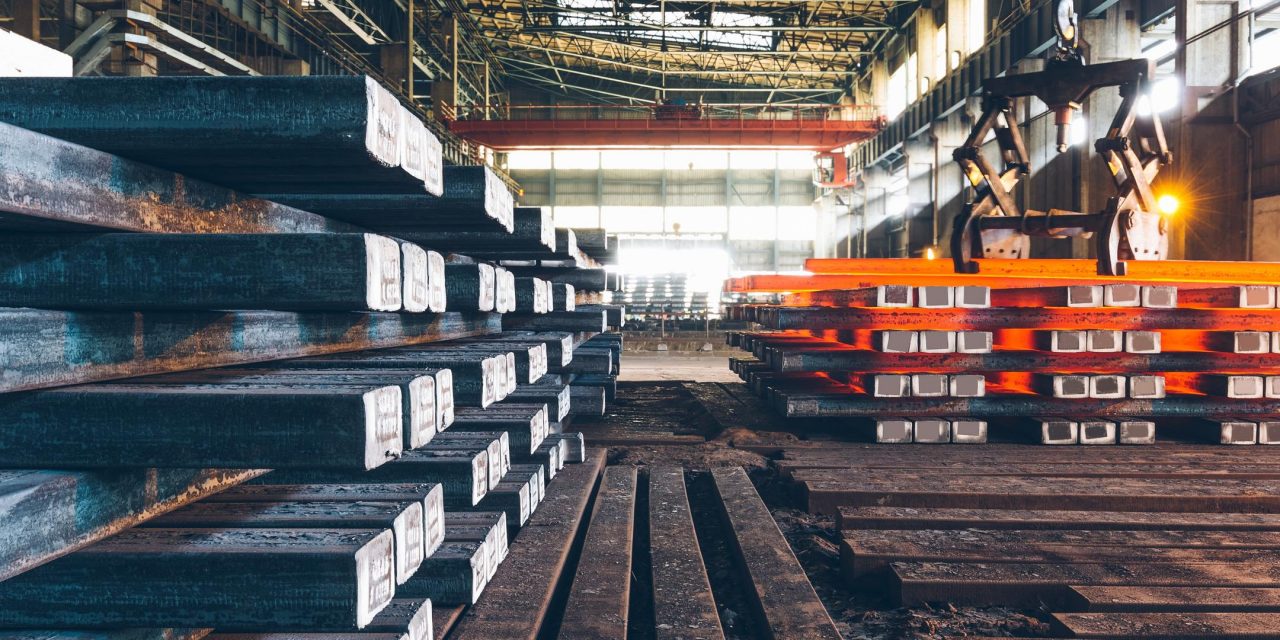
Japan: Nov iron, steel exports rebound 4% from Oct; spikes 18% on year
Japan exported 2.88 million mt of iron and steel products in November, a 3.6% rebound from October and spiking 18.3% year on year, data from the Japan Iron and Steel Federation showed Dec. 27, amid strong demand from several main destinations.
Looking ahead to 2022, the JISF projected annual exports will be similar to 2021, citing a recovery in the global economy and forecasts from the World Steel Association, which expects global steel demand in 2022 to rise 2.2% annually.
Last month, South Korea topped the list of destinations receiving 513,448 mt of Japan’s iron and steel exports, up 7.3% month on month and surging 52.1% against November 2020, the JISF data showed. This comes amid an expanding manufacturing sector as evidenced by the country’s purchasing managers’ index, which widened to 50.9 in November, from 50.2 in October.
Thailand was next at 449,727 mt, down 4.3% from October, but up 14.6% year on year. The mixed outcome seemed reflected in the Thai manufacturing PMI, which slowed to 50.6 in November, from 50.9 in October.
Exports to China were mixed at 419,091 mt, up 3.5% from October, but dipped 0.8% annually. China’s official manufacturing PMI, as published by the National Bureau of Statistics, rebounded to 50.1 in November from 49.2 the month before.
Ordinary steel products made up a good proportion of the overall November exports, coming in at 1.88 million mt, up 4.4% from October 2021 and 20.1% from November 2020. Of the ordinary steel products, hot-rolled wide strips contributed 957,545 mt, up 14.7% month on month and 27.6% year on year.
Of the hot-rolled wide strips, 163,947 mt headed to Thailand, down 3.1% from October, but gained 22.8% annually. About 161,427 mt of the same strips found their way to South Korea, both spiking 26.6% and 70.5% on a monthly and annual basis, respectively.
With the November figures summed up, overall exports over January to November 2021 was 31.59 million mt, up 6.8% versus the corresponding 11 months the year before, and likely to exceed the 32.14 million mt exported for all of 2020.
— Clement Choo

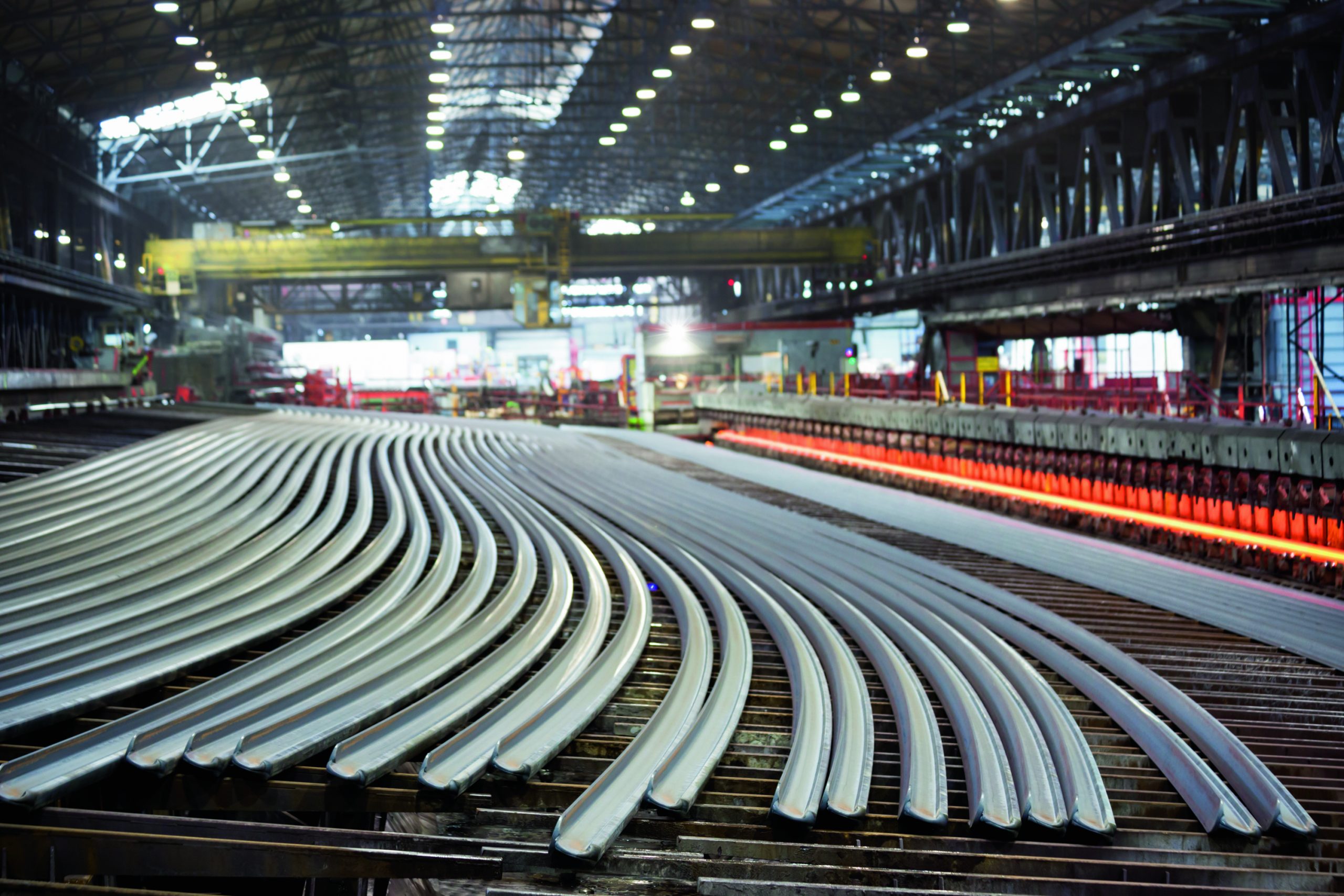
Asian steel output remains firm outside of China
Asian crude steel output fell further in November on the continued cut back in output in China, according to World Steel Association data. Excluding China, output was also down month-on-month but was still growing strongly on-year, Kallanish notes.
Total Asian crude steel output totalled 97.748 million tonnes, down 15.62% year-on-year and 2.6% month-on-month in November. China, the region’s top producer, saw November production of crude steel hit 69.31mt, 3.17% lower m-o-m and slumping 22% on-year. China is seeing a slight rebound in output in December after it completed output reduction targets by the end of November.
Asia excluding China, meanwhile, saw crude steel output drop 1.2% m-o-m to 28.438mt, but this was largely down to the shorter month. Output was still up 5.4% y-o-y. Several countries continue to see stronger output due to the delayed recovery from Covid-19 in 2020 and the steady increase in installed capacity.
Second-largest regional producer India saw crude steel output fall 2.25% from October to 9.825mt. This was up 2.25% from last year. Meanwhile, Japan, the third-largest producer of crude steel, produced roughly 8.04mt, down 2.24% m-o-m but up 10.71% on-year.
South Korea’s steel production in November increased 2.42% m-o-m and 2.72% y-o-y to 5.922mt. Vietnam’s output was up 0.95% m-o-m and 6.72% y-o-y at 1.906mt. November production in Taiwan was 6.78% y-o-y but 3.08% lower on-month at 1.89mt.
January-November steel production across the region was 1.257 billion tonnes, up 1.11% y-o-y. China produced 944.855mt, down 2.84% y-o-y. Output in India increased 19.27% to 107.307mt.
Excluding China, Asia’s combined production was up 15.26% y-o-y across January-November, totalling 312.55mt. With production of 88.397mt, Japan was the third-largest producer of steel in Asia between January-November. This quantity was 16.84% more y-o-y. In South Korea and Vietnam, output over the opening 11 months rose by 5.56% and 20.41% respectively to 61.169mt and 17.929mt. January-November production in Taiwan totalled 21.052mt, up 10.5% y-o-y.


US formalises EU quota arrangement
US President Joe Biden has made a presidential proclamation formalising the tariff-rate quota agreement on steel imports from the European Union.
Through the end of 2023, 3.3 million tonnes of steel products will be allowed to enter the US from the EU tariff-free. Any shipments above this quantity will be subject to the 232 tariffs originally imposed in 2018 by then-President Donald Trump and maintained by the current administration.
President Biden was careful to maintain that all subject steel imports must be melted and poured in an EU member country to receive the duty-free treatment, Kallanish notes.
Additionally, all exclusions that were granted in fiscal 2021 (1 October, 2020, to 30 September, 2021) by the US Department of Commerce allowing EU steel products to enter the US duty-free will be renewed for another two calendar years.
The US and EU have agreed to expand trade remedy coordination and to address non-market excess capacity, setting a deadline of 31 October, 2023, to conclude steel and aluminium negotiations between the two regions.
President Biden, citing “national security interests,” also determined that it would not be necessary or appropriate to remove the current 10-25% tariffs on steel products from other countries at this time.
The American Iron and Steel Institute, which represents the interests of the domestic steel industry, responded favourably to the proclamation.
“We are particularly gratified that the president’s proclamation emphasises that only steel melted and poured in the EU will benefit from this alternative arrangement,” AISI president and ceo Kevin Dempsey says in a statement. “Proper implementation and enforcement of the tariff-rate quota will be crucial to preventing another steel import surge that would undermine our industry and destroy good paying American jobs…We also welcome the president’s direction to the Secretary of ommerce to initiate a regulatory review of the section 232 exclusions process that will include a focus on enhanced consultations with US companies and labor organisations.”
Laura Miller USA

Turkey’s cold-rolled coil exports jump, Italy top market
Turkey’s cold-rolled coil exports jumped to 547,800 mt in January-October 2021, 83% higher year on year, as South European demand supported Turkish mills’ export volumes, despite EU quotas, according to the latest monthly Turkish Statistical Institute (TUIK) data.
The downfall seen in demand in export markets in 2020 due to the COVID-19 pandemic is another reason for this sharp year-on-year rise, sources noted.
According to the TUIK data, Italy became Turkey’s main CRC export market by far in the first ten months at 165,800 mt, three-fold higher on year, while Spain was Turkey’s second-largest CRC buyer in that period at 68,500 mt, double year on year.
Turkish mills’ CRC exports to Belgium also rose year on year to 51,500 mt in January-October, more than double on year.
North American demand also supported Turkish mill export volumes in 2021. Canada became another top CRC market for Turkish mills in January-October 2021 at 45,000 mt, around fourfold higher on year, while the US was Turkey’s fifth-largest CRC customer at 41,000 mt in that period, sharply higher than 17,300 mt exported to that country in the first ten months of the previous year.
Turkish mills also shipped 31,700 mt of CRC to Bulgaria, while shipments to Romania totaled 24,500 mt.
Turkish mills’ other CRC exports in Jan-Oct 2021 were: Iraq (16,700 mt), Portugal (13,500 mt), Poland (13,200 mt) and the UK (12,200 mt), the latest data showed.
— Cenk Can
US, EU target Oct 2023 to wrap up global steel, aluminum negotiations: Biden
The US and EU will seek to conclude negotiations by Oct. 31, 2023, on global steel and aluminum arrangements to restore market-oriented conditions and support the reduction of carbon intensity across modes of steel and aluminum production, according to a proclamation issued by President Joe Biden Dec. 27.
In October, the US and EU said they would negotiate further arrangements for trade in the steel and aluminum sectors that take account both global non-market excess capacity as well as the carbon intensity of these industries. The US and the EU agreed to form a technical working group to enhance their cooperation and facilitate negotiations on these arrangements, and will invite like-minded economies to participate in the arrangements, they said.
The deal between the two parties to target these issues is part of a larger agreement reached in late-October to replace the existing US Section 232 tariffs with a tariff-rate quota for EU countries beginning Jan. 1. The proclamation issued by Biden Dec. 27 makes the change official.
From Jan. 1, 2022, forward, a tariff-rate quota system will replace the existing 25% steel tariff and 10% aluminum tariff that former President Donald Trump imposed on EU imports under Section 232 legislation in March 2018.
The aggregate annual steel import volume under the TRQ is set at 3.3 million mt across 54 product categories and allocated on an EU member state basis, in line with the 2015-2017 historical period.
The aggregate annual import volume is set at 18,000 mt for unwrought aluminum under two product categories, and 366,000 mt for semi-finished aluminum under 14 product categories. These import volumes also will be allocated on an EU member state basis but will be in line with the 2018-19 historical period, with the exceptions of foil, which will use 2021 annualized data.
— Justine Coyne
LME scrap, rebar trading volumes increase
Most near-term scrap and rebar futures contracts on the London Metal Exchange saw losses over the week to Dec. 23, while trading volumes increased.
Platts assessed the December scrap contract up $3/mt week on week at $464/mt on Dec. 23. The January contract decreased $2/mt to $451.50/mt. The February contract fell $9/mt week on week to $440.50/mt. The March contract dropped $7/mt to $435/mt.
The backwardated structure for the December-February forward curve strengthened week on week, suggesting that futures traders are firmer on their expectations of a further near-term drop in physical scrap prices.
The backwardation over the February to March portion of the forward curve softened.
Spot prices for physical imports of premium heavy melting scrap 1/2 80:20 dropped $4/mt week on week to $461/mt CFR Turkey on Dec. 23, as several scrap cargoes were heard booked the week started Dec. 20.
The Turkish lira strengthened sharply against the US dollar over Dec. 20-22 after President Recep Tayyip Erdogan said the government would cover losses for lira deposit holders, should lira losses against foreign currencies exceed banks’ interest rates.
Market sources expect this appreciation in the currency against the dollar to subsequently improve demand for scrap cargoes. Sources said four mills were actively seeking further January shipment cargoes, with some also keen to buy for February shipment.
“Since yesterday, mills are actively looking for January shipments, and Christmas is at the door, so I think we already touched the bottom,” one agent source said.
Weekly LME scrap futures trading volumes over the week to Dec. 23 totaled 31,360 mt, up from 22,300 mt recorded the previous week.
Most near-term rebar futures contracts also saw losses over the week to Dec. 23. Platts assessed the December contract down $2.50/mt week on week at $694.50/mt on Dec. 23, while the December contract lost $4/mt to $685.50/mt. The January contract dipped 50 cents/mt to $679/mt, and the February contract rose $4.50/mt week on week to $674.50/mt.
The backwardated structure of the December-January portion of the forward curve strengthened slightly week on week, suggesting that futures traders expect further near-term downtrend in physical prices.
The backwardation over the January to March portion of the forward curve softened suggesting that futures traders expect the physical price downtrend over the period to be less drastic than previously anticipated.
Turkish physical rebar export prices were stable at $690/mt FOB on Dec. 23, after a drop to $682.50/mt on Dec. 20, as Turkish mills tried to maintain workable levels for rebars in the export market despite slow demand. Though market sources also reported a fresh deal totaling 15,000 mt to Germany by a Marmara mill, overall the market remained quiet while the Turkish lira recovered from record lows.
Rebar futures weekly trading volumes on the LME totaled 13,930 mt, up from 12,850 mt traded volume the previous week.
Elsewhere, Indian scrap futures saw three consecutive days of trading over Dec. 20-22, with a total of 180 mt traded. A total of 2,850 mt has traded so far on the contract, which settles basis the Platts CFR Nhava Sheva shredded scrap index, since its launch in late July.
The daily outright spread between Turkish export rebar and import scrap was assessed at $229/mt Dec. 23, up $4/mt week on week.
— Rabia Arif

Asian stainless CRC inches on strong nickel
Asian stainless cold-rolled coils increased in the week to Dec. 24, supported by stronger nickel prices and improved sentiment led by strengthening Chinese domestic market.
S&P Global Platts assessed 304 grade 2 mm 2B stainless CRC at $3,120/mt CFR East and Southeast Asian ports Dec. 24, up $15/mt on the week.
Nickel prices strengthened and rose above the $20,000/mt mark again during the week. The official nickel cash price on the London Metal Exchange settled at $20,175-$20,180/mt Dec. 23, up $595/mt on the week.
Chinese domestic market continued its slight rebound, which made market participants believe prices would be more stable before the Lunar New Year holidays, as traders would start to leave the market since early January.
Market inventory remained relatively low, which would continue to support the spot market along with strong raw materials, said a Chinese trader.
One Chinese mill was heard offered about $2,900/mt FOB for 304 CRC for end-February and early March shipment. The offering level for 304 CRC for immediate delivery should also pick up but there were no buying activity due to the holidays, said another Chinese trader. “Buyers would return after the New Year holidays,” he said.
The most actively traded February 2022 stainless steel contract on the Shanghai Futures Exchange closed at Yuan 16,770/mt in the morning session on Dec. 24, up Yuan 775/mt, or 4.8%, week on week. The futures had been up for two straight weeks after downward corrections seen since late October.
— Staff
Turkish mills continue to pull down domestic scrap buying prices
Turkish steel mills continued to cut their lira-denominated domestic scrap buying prices for the third consecutive day on Dec. 24, as the currency continued to strengthen after the government announced support measures Dec. 20.
Turkish deepsea import ferrous scrap prices inched up on Dec. 23, as a fresh Venezuela-origin cargo was booked. S&P Global Platts assessed Turkish imports of premium heavy melting scrap 1/2 (80:20) Dec. 23 at $461/mt CFR, up $1/mt on the day. The index has fluctuated in a $460-$465/mt CFR range since Dec. 15.
Colakoglu, one of Turkey’s largest EAF-based steelmakers, cut its domestic buying price again for DKP grade (auto bundle) scrap in this sentiment to Lira 6,055/mt ($510) on Dec. 24, while the company’s extra grade domestic scrap buying price fell by the same amount to Lira 5,580/mt ($470/mt). The exchange rate was Lira 11.9/$1 on Dec. 24 at 12 pm Turkey Time.
The DKP scrap buying price for one of Turkey’s largest alloy steel producers, Asil Celik, was set at Lira 5,965/mt ($502/mt), while the company’s extra grade domestic scrap buying price fell to Lira 5,200/mt ($438/mt).
Kardemir, Turkey’s integrated long steelmaker pulled down its extra grade domestic scrap buying price to Lira 6,115/mt ($516/mt) on Dec. 24. The Eregli mill of Erdemir Group, Turkey’s largest integrated steelmaker, also cut its DKP domestic scrap price to Lira 5,835/mt ($493/mt), while its extra-grade scrap buying price declined to Lira 5,830 ($492/mt), according to the mill’s updated domestic scrap buying price lists seen by S&P Global Platts.
Turkish mills use 30 million mt of steel scrap per year and have been procuring about a quarter of it from the domestic market.
— Cenk Can
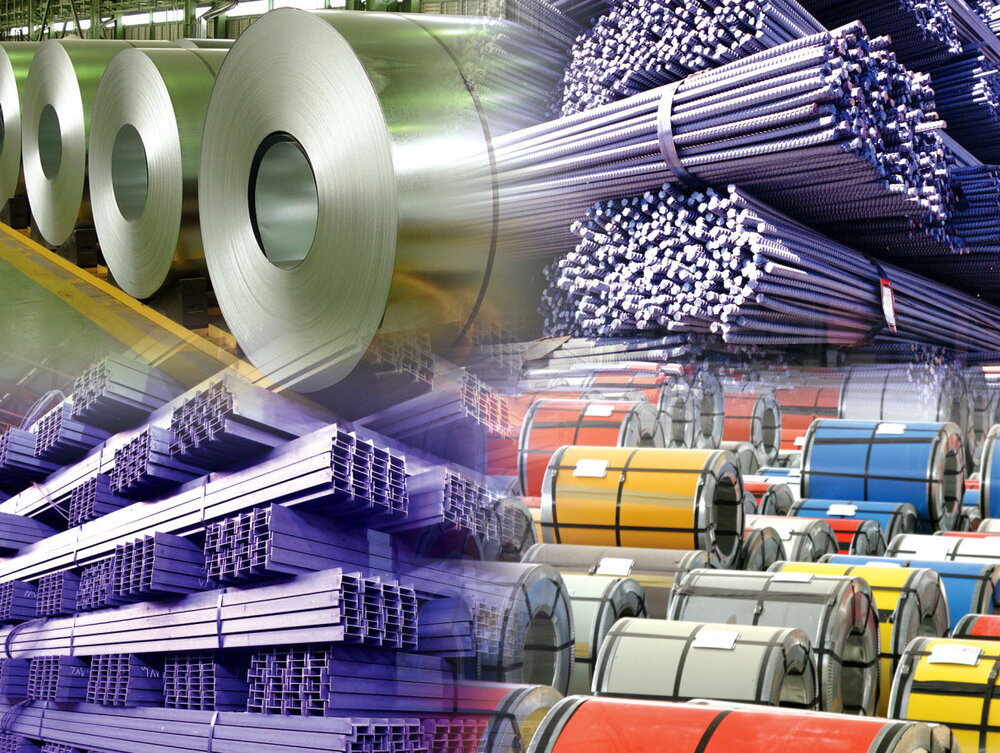
Kallanish Steel: 2021, a year like no other
2021 was a year like no other. Amid the rapid global spread of Covid-19 in 2020, the lockdowns that followed and the fear and uncertainty that gripped the world, few would have imagined that economic activity would rebound with so much force, so rapidly. Mankind developed vaccines and quickly adapted to life with the virus, but, after significantly scaling back operations in the first half of 2020, industry struggled to ramp up supply to match the demand boom that came next.
The year was one of two halves.
The first was dominated by the shortfall in supply, which sent steel prices spiralling globally. China, whose demand had single-handedly propped up the steel market for much of 2020, saw crude steel production rising rapidly despite attempts to curb it, while end-user demand, more importantly, soared even higher. Gone was the earlier notion that Chinese demand would stabilise at lower levels amid the country’s shift to consumption-led growth. This was coupled with still limited Chinese steel exports, as the government cancelled export tax rebates on most steel products in May.
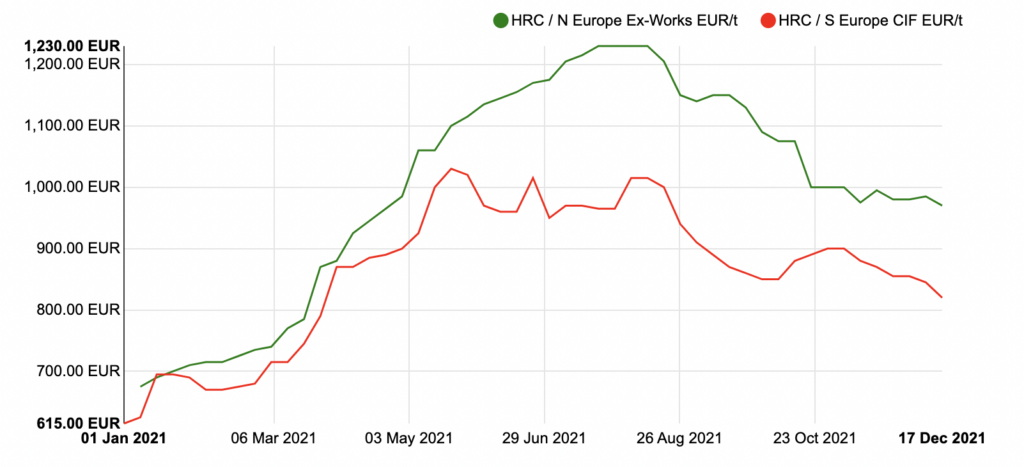
European hot rolled coil prices in April meanwhile reached the previously mythical level of €1,000/tonne as mills struggled to meet demand, hiking prices on a weekly basis. This was despite semiconductor shortages forcing increasingly more carmakers to curb production and therefore not take up the procurement of automotive steel stipulated in their annual contracts.
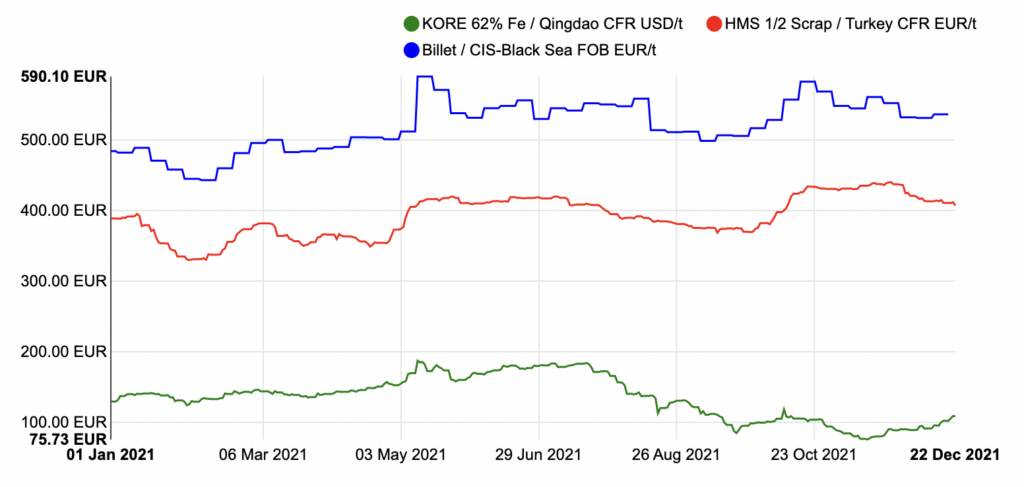
May was a month for record prices, with the KORE 62% Fe index surging to an all-time high of $226.07/tonne cfr China on 10 May, driven by speculation, before China’s government intervened to cool the market. HMS 1&2 80:20 scrap surpassed $500/t cfr Turkey on 11 May for the first time in ten years, later peaking at $512.5/t. CIS billet surged to $715/t fob Black Sea on 10 May.
The headlines that month were dominated by expectations China would implement an export tax on HRC, as part of its push to limit exports to high value-added products. To this day, however, no tax has been implemented, and it looks increasingly unlikely that this will happen.
Given the supply shortages gripping Europe, many expected the European Commission to revoke or relax safeguard measures at the end of their three-year tenure in June. However, much to the delight of EU steelmakers and the dismay of end users, duties were extended for another three years. The swearing in of Joe Biden as US President in January, meanwhile, did nothing to change Section 232 measures, convincing steel market participants that protectionism was here to stay.
See the latest safeguard measures
Summer was a turning point, as China implemented environmental restrictions to curb steel production, ordering steelmakers to ensure 2021 production remains at or below 2020 levels. The KORE 62% Fe index slipped below $200/t at the end of July and has not returned to this level since. A new surge in Covid-19 cases in Asia, meanwhile, slashed rebar demand on the continent and kept Turkish mills out of the market in August, hampering scrap price growth.
Rather than the typical post-summer steel demand rebound, global markets remained subdued in September, as soaring input costs began to seriously pressure the margins of steelmakers in regions such as Europe and Turkey, with some mills announcing they would need to curb production due to costlier energy, while others implemented energy surcharges. Moreover, concerns over the collapse of Evergrande and a resulting debt contagion stifled China’s real estate market. (Read related article here)
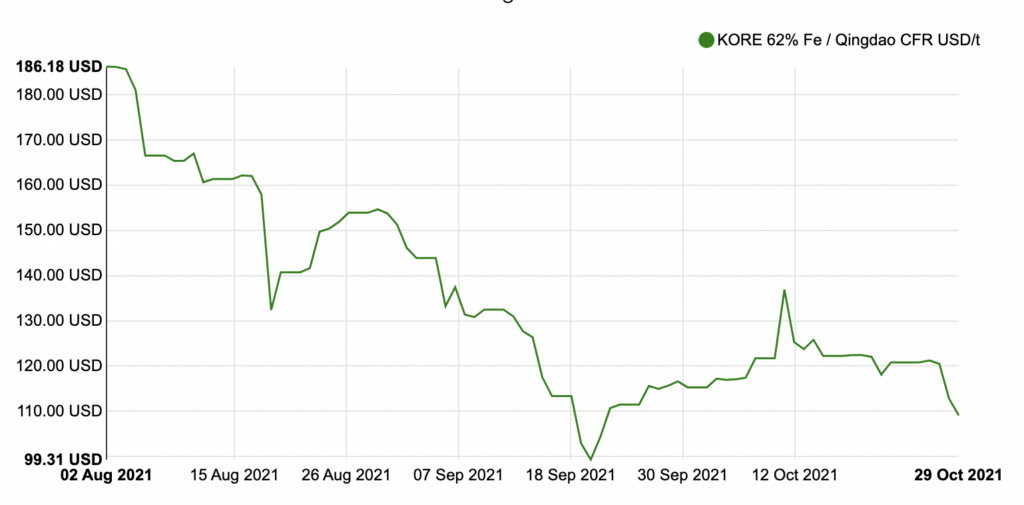
There was brief hope that demand would rebound after China’s Golden Week holiday in October, but this never materialised. Instead, Chinese prices began to collapse on weak Chinese steel demand, real estate activity and fixed asset investment. KORE 62% Fe fell to $86.79/t on 15 November – the lowest level since May 2020.
At the end of October, the US and EU signed a new trade deal to allow over 4 million tonnes/year of EU steel to enter the US duty free. This sent other US allies, such as Japan, Korea and the UK, scrambling to negotiate similar agreements with the world’s largest economy. Premium coking coal prices, meanwhile, peaked at an all-time high exceeding $410/t fob Australia at the beginning of that month. In the US, HRC finally joined the downward trend in the rest of the world and started to come off in the second half of October and into November after peaking at an astonishing $1,960/short ton or $2,160/metric tonne.
Costlier inputs have continued to squeeze Turkish mills throughout November and December, pricing them out of Asian rebar markets, a situation that has been successfully exploited by supplier mills in the Middle East, a market that still a decade ago was heavily reliant on imports. The lira recording repeated all-time record lows in recent weeks has meanwhile hampered business in the Turkish domestic market. Turkish mills have consequently substantially reduced scrap purchases, which has seen prices of the feedstock come off in December after they had remained stubbornly high even amid iron ore dropping after the summer.
Amid these market developments, the global steel industry rapidly accelerated the decarbonisation process in 2021, as existing steelmakers announced ambitious low-carbon upgrades and new “green” steelmaking investments were established, most notably in Europe. Hydrogen has become the new buzz word of the day – this abundant gas is expected to fuel not just steel but industrial processes all over the world in the coming decades. The EU is encouraging the process with its Emissions Trading System, which penalises high carbon emitters. EU carbon permit prices have reached record levels, exceeding €80/t in December versus below €35/t at the start of the year. Until new technology is sufficiently developed, the push towards green steelmaking will increase production costs and support higher steel prices in some regions. The increased use in steelmaking of scrap as an immediate carbon reduction method will put pressure on the feedstock’s availability, again supporting prices. These trends are likely to become more apparent in 2022.
Another factor to watch will be how the US-EU trade pact affects each of the markets involved.
- What products will be imported into the US from the EU, from which producers and in what tonnages, and will this soften US domestic prices, which are considered by many as unsustainable?
- What other countries will the US agree trade deals with and will this create a closed market of certain regions that excludes others?
- What will be the outcome of the EU’s latest safeguard review, due for completion next June?
- To what extent will EU and US steel demand benefit from the Next Generation EU recovery instrument and US infrastructure bill respectively?
- With the Democrats expected to lose next year’s mid-term elections and a turbulent political year anticipated in the country, how will the steel industry be impacted?
- When will semiconductor shortages ease and automotive production rebound?
- Will manganese and graphite electrode shortages resurface to the detriment of steelmakers?
- What will happen to the Chinese real estate market in 2022 and what economic consequences will this have globally?
- What will happen to the steel surplus resulting from reduced Chinese steel demand next year?
Kallanish’s global team of journalists will bring you the answer to these questions and more, with the latest industry developments reported as and when they happen.
In the meantime, I wish you all a peaceful and reflective holiday period, and a Happy New Year.
Sincerely, Adam Smith
Global Editor
Kallanish Steel
German crude steel output points up
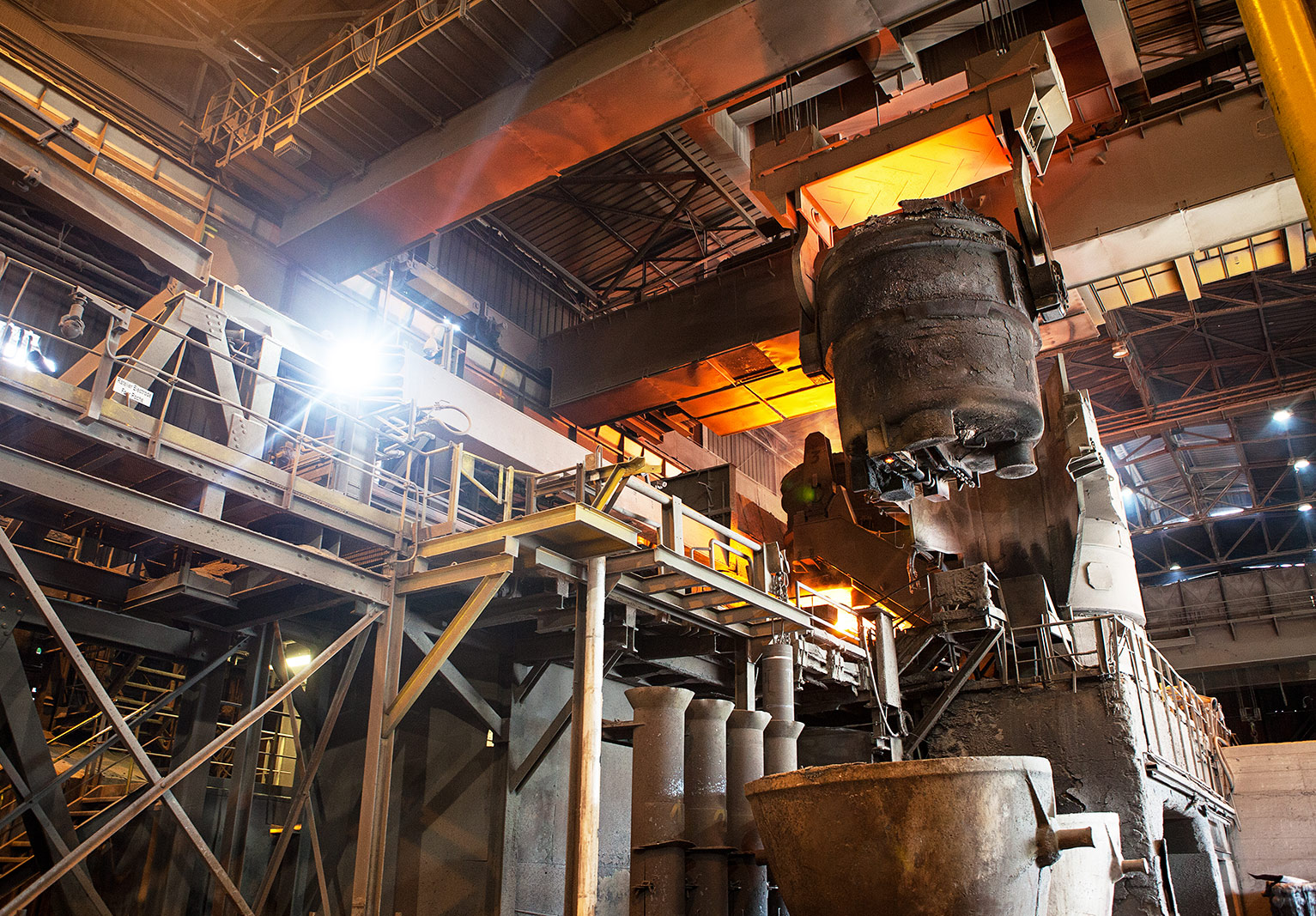
Crude steel output at German mills from January through November this year rose 13.5% over the first 11 months of 2020 to 36.92 million tonnes, according to figures provided by steel federation WV Stahl.
In November alone, production was on par with November 2020, at 3.37mt. Output at oxygen-route mills rose by 4.5% to 2.35mt, whereas that of EAF mills sank by nearly 10% to 1.01mt, Kallanish hears.
This apparently odd development can be attributed to a base effect, which already showed up earlier this autumn. The resurgence of production in late 2020 started initially at EAF mills, which were faster and more flexible than BOFs to respond to the rapid demand resurgence following lockdowns.
The fourth quarter saw the restart of the country’s biggest blast furnace, at thyssenkrupp’s works in Duisburg, following a reline. Therefore, it is likely that the full year will reach the 40mt mark.
Christian Koehl Germany