


European coil and green steel round-up: domestic prices continue to fall
European coil prices dropped in the week to 4 July due to low demand and pressure from competitive import offers. A majority of European steelmakers have been willing to provide substantial discounts in an attempt to fill their production lines for summer.
“Demand is weak, and the mills’ order books are short. And the main thing dragging the prices down is the desperation of the mils,” a trader said.
EU mills have also been avoiding blast furnace stoppages and significant crude steel production cuts as the number of the free CO2 emission allowances are granted each year based on the emissions in the past few years, some sources said. As a result, a stoppage now could result in higher production costs in the coming year as a steelmaker would have to purchase emission allowances.
McCloskey’s weekly marker for Northwest European domestic hot-rolled coil (HRC) fell EUR20/t on the week to EUR550/t ex-works.
The region’s integrated mills have been offering and trading September delivery material at EUR540-570/t ex-works, with the majority of data heard within the EUR540-560/t ex-works range.
Some re-rollers were reported to be able to give even lower prices.
McCloskey’s weekly marker for South European domestic HRC declined by EUR10/t on the week at EUR530/t ex-works.
Italian mills have been offering HRC at EUR530-540/t ex-works, bids have been reported at EUR500-510/t ex-works and market sources estimated achievable prices at EUR510-520/t ex-works.
Reduced domestic supply in Italy failed to offset the downward pressure from import competition.
Acciaierie d’Italia (ADI) has remained inactive in the market. In late June, Minister of Enterprise and Made in Italy (MIMIT), Adolfo Urso told trade unions that all ADI’s blast furnaces (BFs) were at risk of closure. Italian authorities have been negotiating the sale of the plant to several potential buyers, including Baku Steel and JSW Steel.
On 4 July, the MIMIT held a meeting regarding energy supply for the decarbonization of ADI. The next meeting will take place on 8 July.
Import offers moved down further triggered by a drop in prices from Indonesia. One of the country’s mills has lowered offers for bigger lots of HRC by EUR20/t from previous prices to EUR450/t CFR Italy. The material was offered with arrival in the fourth quarter to ensure customs clearance before the carbon border adjustment mechanism (CBAM) comes into force in 2026.
Currently HRC from Indonesia is exempt from the scope of safeguard measures in the EU, so Indonesia has been exporting the material freely without risks related to tariff-rated quotas.
The European Commission is planning to unveil proposals for alternative steel safeguard measures in September this year, to replace the current measures which are due to expire on 30 June 2026.
And market participants believe that Indonesia is trying to increase exports to the EU this year before any potential changes in safeguard or other trade measures come into force.
“Indonesia decided to start a farewell sale – they are offering and selling HRC at EUR450/t CFR for October delivery, so that material would arrive before CBAM, any possible changes in safeguard and potential anti-dumping start,” an Italian source said.
Import offers from Turkey have been reported at EUR485-490/t CFR Italy. The price includes anti-dumping duties.
Despite competitive import offers, European buyers have been showing less interest in material with longer lead times. This is due to the CBAM duties for material that will arrive next year. Market participants citied a lack of clarity on the CBAM policy, which continues to change, increased bureaucracy and potential duties of EUR50-200/t per tonne of steel, depending on CO2 content and the origin of the material.
Green steel
Activity in the green steel market remained slow due to the pessimistic mood in the traditional steel market.
Lack of standards for low-CO2 steel slowed down development of the green steel market, and distributors avoided putting green steel coil in stock. But buyers’ interest in back-to-back transactions for particular projects has been slowly growing.
Some market sources said that European authorities have been reviewing proposed solutions to define green steel and a decision is expected by the end of 2025.
Mills have been offering green HRC (CO2 content below 0.8 mt scopes 1-3) at premiums of EUR200/t. These prices are not considered realistic by buyers, instead estimating workable premiums at EUR50-100/t.
McCloskey’s reduced carbon marker, calculated in reference to all green HRC premium indications collected in the week prior to publication, stands at EUR64.39/t on 4 July.
European Coil Prices 4 July
| Term | Marker | Change | |
| Weekly Northwest Europe steel coil | |||
| Northwest Europe ex-works HRC | EX-WORKS | 550 | -20 |
| Northwest Europe ex-works CRC | EX-WORKS | 655 | -10 |
| Northwest Europe ex-works HDG | EX-WORKS | 670 | -20 |
| Weekly South Europe steel coil | |||
| Italy ex-works HRC | EX-WORKS | 530 | -10 |
| South Europe CIF HRC | CIF | 490 | -20 |
| Weekly Green steel | |||
| Green Northwest Europe HRC premium (scopes 1-3 CO2 0.8t) | 75 | 0 | |
| Green Northwest Europe ex-works HRC (scopes 1-3) | EX-WORKS | 625 | -20 |
| Green HRC premium (scopes 1-2 CO2 0.5t) | 75 | 0 | |
| Green Northwest Europe ex-works HRC (scopes 1-2) | EX-WORKS | 625 | -20 |
| Green HRC reduced carbon price (scopes 1-3) | 64.39 | 3.2 |


EUROMETAL: The future of the European Steel Distribution industry in 75th anniversary year
EUROMETAL, one of the most established and influential organizations in the European steel distribution sector, launched its 75th Anniversary conference in Luxembourg today. The event brought together industry representatives, industry leaders and politicians from across Europe to shine a light on the present and future of the steel industry.
Alexander Julius, President of EUROMETAL, opened the conference and stated that the 1990s was a golden era for the sector in terms of economic relations between China and Europe. At that time, China was importing steel products and sub-industry products from Europe as an emerging market, whereas today China has become a powerful producer worldwide and Europe is increasingly importing steel and products from China and other Asian countries. Julius emphasized that this transformation is a major challenge for the European industry and that Europe now needs to develop new strategies to remain competitive in terms of production and technology.
In his speech, he also drew attention to production declines in the European steel sector, overcapacity in global markets and unfair competition. In order to meet these challenges, Europe needs to develop a stronger trade policy, innovative solutions in energy policies and policies centered on sustainability.
The role of digitalization and green transformation
Carlo Thelen, Director General of the Luxembourg Chamber of Commerce, stated that digitalization and artificial intelligence will play a critical role in the European steel distribution sector. Artificial intelligence technologies will accelerate the sector in areas such as carbon footprint tracking, demand forecasting, logistics optimization and improving production processes. However, it was emphasized that many systems are still not integrated in the sector today and that digital transformation needs to be expanded.
Thelen added that the steel distribution sector needs to move to more agile, flexible and hybrid business models in order for Europe to achieve its green transformation goals. He emphasized that information management, logistics and environmental excellence should be prioritized in the sector as the boundaries between production, transformation, distribution and service are blurring.
Education, talent and industrial sovereignty
At the conference, it was stated that the technical and digital talent gap in Europe poses a serious threat. It was emphasized that for the sustainable development of the sector, it is necessary not only to train the new generation, but also to improve the skills of existing employees, support career transitions and long-term career planning. It was stated that Luxembourg Chamber of Commerce adapts its training programs according to sectoral needs.
In addition, it was stated that industrial sovereignty must be protected in order for European industry to remain strong and resilient in the face of global uncertainties, supply chain issues and competitive pressures. Europe needs to develop strategies to strengthen its industrial base through national and regional coordination.
EUROMETAL’s contribution to the industry and future vision
EUROMETAL has been a unifying and guiding force in the European steel distribution sector for 75 years. Over the years, the organization has been active in a wide range of sectors covering iron and steel service centers, stocking, trading and distribution, providing its members with information flow, connections and intra-sectoral cooperation.
At the conference, EUROMETAL’s 75-year journey from the past to the present was explained and how it has developed in parallel with Europe’s economic and political changes. This journey, which began in the 1950s with the reconstruction of post-war Europe, is now evolving into a new era of digitalization and green transformation.
EUROMETAL and industry representatives will continue to work together to build a sustainable, competitive and technologically leading steel distribution sector in Europe. The 75th anniversary celebrations were seen as a symbol of this unity and determination in the industry.


Antonio Marcegaglia: Europe risks trade isolation, prices nearing rebound
Flat steel prices are expected to reach their lowest point this summer before starting to recover in the fourth quarter. This will be driven by the European Commission’s safeguard measures review, existing quota systems, and the incoming Carbon Border Adjustment Mechanism (CBAM), according to Antonio Marcegaglia.
“Demand is structurally declining in Europe – by at least 15 million tonnes over the past six to eight years – reaching just 130 million tonnes last year,” Marcegaglia told Kallanish during EUROMETAL’s 75th Anniversary conference held in Luxembourg this week. This decline, he added, is occurring amid a broader global economic slowdown. “We must not underestimate the need to support European demand before talking about decarbonisation and trade”.
While producers have highlighted overcapacity and called for stronger border protections, Marcegaglia questions the actual extent of excess capacity in the global market. “Talking with my Chinese commercial partners I do see and I do expect a cut of 300 million tonnes capacity in the next five to eight years or even sooner, and [their] export-oriented model is no longer working,” he observed.
Marcegaglia acknowledges the need for Europe to shield its industry from unfair competition but highlights that protectionism alone cannot be the solution. “We need to protect to a certain extent but I do believe the EU, because of its nature as a re-exporting economy, needs to remain in the global supply chain actively working and not isolated,” he noted.
Referring to the ongoing global trade tensions created by US President Donald Trump, Marcegaglia conceded that chaos can work as a negotiation tool, but even the United States cannot afford to turn its back on global trade.
Europe has a structural competitive gap with Asian countries, created by high energy costs, lack of raw materials, the highest labour costs linked with being a developed economy and more developed social welfare. This gap will remain.
However, the European supply chain has a growingly sophisticated market that needs to be developed. It possess the best technologies for steel, a culture of innovation, scrap availability that is not yet fully utilised, a resilient, capillary and well-organised distribution supply chain, and social and political stability, Marcegaglia continued. If well managed, the green transition could become an opportunity.
Europe also boasts a proximity to markets in need of steel in the near future, such as the Middle East and Africa.
Marcegaglia is implementing a partial upstream integration with the acquisition of a stainless steel mill in Sheffield, UK, and the new Fos-sur-Mer hot strip mill project in the south of France. The company aims in future to reach zero debt, becoming less reliant on financial institutions, and post €10 billion ($11bn) in turnover and €1 billion in Ebitda. In 2024, the company registered €6.8 billion in revenue and €430 million in Ebitda.
Natalia Capra France


Alexander Julius: Industry must utilise political problem-solving momentum
EUROMETAL has begun collecting information from EU associations, national federations, and steel users regarding the import into the EU of low-priced steel derivatives. The association is analysing the growth in imports compared to the ongoing decline in European steel consumption and domestic production, president Alexander Julius said at the EUROMETAL 75th anniversary event attended by Kallanish.
Brussels and national governments are “opening their doors and they are listening”, he noted at the event in Luxembourg on Thursday. “We need to utilise this development and momentum, continuing to address the problems of our industry.”
Julius remains optimistic about the potential to establish a level playing field also for downstream companies in Europe. “Also to the European Commission, we have emphasised more than once that a green transformation, electrification and development of a European defence programme demand a healthy EU manufacturing industry with a healthy steel distribution,” he continued.
Collecting detailed information on unfair import practices related to steel derivatives is crucial, Julius added. He urged companies and industry associations to share as much data as possible as the European Commission can only act when properly informed.
Europe is becoming increasingly reliant on imports, particularly from China and other Asian countries, Julius warned. “China is now more digitalised and electrified than Europe,” he said, adding that Europeans have grown complacent, discussing reduced working hours and even four-day workweeks, as is the case in Germany.
He also highlighted growing geopolitical instability, citing US President Donald Trump’s “America First” stance, Russia’s ongoing war in Europe’s neighbourhood, and China’s strategic goal of becoming the world’s dominant supplier of hardware and software. These developments, Julius pointed out, should serve as a wake-up call for European policymakers and as an opportunity to rebuild a more independent and resilient Europe.

Meanwhile, Carlo Thelen, director general of the Luxembourg commerce chamber, urged Brussels to simplify the complex European regulatory framework and to develop pragmatic economic tools, stressing that businesses need greater clarity and predictability.
Speaking on the role of innovation, Thelen underlined the chamber’s mission to support companies in investing in technology. The potential of artificial intelligence may act as a key accelerator for steel distribution, provided it is accessible, reliable, and tailored to industrial needs. Applications such as predictive maintenance, carbon accounting, and forecasting could greatly enhance efficiency.
He called on the steel industry to prioritise technological innovation, noting that logistics, digitalisation, and AI are becoming the new industrial language. “Yet today, too many systems fail to communicate with each other,” Thelen said, warning that this lack of integration is hindering the sector’s progress in improving its environmental performance.
Natalia Capra France

EUROMETAL invited to EU Implementation Dialogue on Customs
EUROMETAL has been invited to participate in the first Implementation Dialogue on Customs, organised by the European Commission and chaired by Commissioner Maroš Šefčovič.
This high-level dialogue on Friday, 11 July 2025 will focus on the EU Rules of Origin from a business perspective, aiming to collect concrete feedback from industry on how the rules are applied and how they can be improved.
The dialogue will be structured in two sessions: discussing the current challenges with regards to the use of Rules of Origin. and developing concrete ways forward to improve Rules of Origin.
EUROMETAL members have been invited to contribute to the EU Implementation Dialogue on Rules of Origin sharing comments, challenges, or suggestions — particularly regarding how these rules affect their daily operations, compliance efforts, trade flows, or overall competitiveness.

EU to propose steel safeguard replacement in September
The European Commission plans to unveil proposals for alternative steel safeguard measures in September this year, to replace the current measures which are due to expire on 30 June 2026, the Commission said in updates to its Clean Industrial Deal on 2 July.
The EU has already tightened the existing steel safeguard measures from April this year to protect the industry from a flood of imports diverted to the EU.
The steel industry requires protection from imports diverted to the EU from their usual outlet markets following the rise of Section 232 tariffs in the US and generally stricter trade policies in the country. In early June, the US authorities doubled tariffs on imported steel and aluminum to 50%.
Decarbonisation requires higher circularity, but scrap recycling in the EU has been on the decline due to a rise in export sales caused by higher prices outside the EU.
European mills have made plans to replace existing blast furnaces with less carbon intensive electric-arc furnaces (EAFs) as part of their decarbonisation route. EAFs use either ferrous scrap or direct-reduced iron as feedstock.
To learn more about the decarbonisation plans of EU steelmakers see McCloskey’s European Green Steel Profile.
The Commission has made data on scrap trade from the Customs Surveillance database publicly accessible as a part of a broader monitoring mechanism for imports and exports of non-ferrous goods and steel. This will help the adoption of new trade measures needed to ensure the sufficient availability of scrap in the EU.
European steel association Eurofer and European Aluminium association urged the Commission at the end of last year to take actions to tackle scrap leakage. The statement was met with criticism from the Bureau of International Recycling (BIR).
Steel exports under CBAM
EU industries remain exposed to unfair international competition, particularly as free allowances under the EU Emissions Trading System (EU ETS) will phase out from 2026 to 2034. Implementation of the Carbon Border Adjustment Mechanism (CBAM) will help prevent carbon leakage for imports, but exports from the EU would suffer as manufacturers in non-EU countries do not face similar carbon costs.
To tackle the risks related to exports, the Commission has proposed using the revenues generated by CBAM – which will be extended – to support production at risk of carbon leakage.
“This would allow the affected producers to be compensated proportionally to the phasing out of the free allowances subject to deliverables on long-term decarbonisation. The scope will need to be established based on objective criteria,” the Commission said.
The proposal will be put forward at the end of 2025 and will be subject to review in 2027.
At the same time the scope of CBAM was proposed to be expanded to downstream goods and introduction of anti-circumvention measures.

EU steel quotas reflect shifting trade dynamics after US tariffs
On the first day of the new EU quota period from July 1 to September 30, some of the import quotas for certain steel products such as HRC, CRC, metallic coated sheets, organic coated sheets and tin mill products, allocated for certain countries like Taiwan, Turkey, Vietnam and China have already been exceeded with products waiting for customs clearance, while over 60 percent of quotas for some steel products have been used up.
Some import quotas for certain steel products have been used rapidly, while the usage of some quotas has declined compared to the beginning of the previous quota period from April 1 to June 30.
The exceeded quotas can be seen in the table below.
| Product | Country | Amount (mt) | Awaiting (mt) | Used (%) |
| HRC (1A) | Taiwan (under other countries) | 112,716 | 128,722 | 114.2 |
| CRC | Turkey (under other countries) | 43,989 | 47,928 | 108.95 |
| Metallic coated sheets (4A) | Vietnam (under other countries) | 119,428 | 152,277 | 127.51 |
|
Metallic coated sheets (4B) |
China | 129,758 | 152,655 | 117.65 |
| Vietnam (under other countries) | 21,207 | 30,702 | 144.77 | |
| Organic coated sheets | Vietnam (under other countries) | 10,843 | 59,738 | 550.94 |
| Tin mill products | Turkey (under other countries) | 7,510 | 15,409 | 205.18 |
| Stainless hot rolled quarto plates | China | 4,974 | 5,214 | 104.83 |
| Stainless bars and light sections | China | 1,302 | 1,747 | 134.18 |
| Wire rod | Algeria (under other countries) | 15,255 | 31,410 | 205.9 |
| Angles and sections | Turkey (under other countries) | 10,243 | 10,503 | 102.54 |
In addition, SteelOrbis sees both upward and downward trends in quota usage in the current period compared to the previous quarter. South Korea has used up 70.55 percent of its 163,077 mt HRC (1A) quota, although the country had used up only 44.73 percent of the quota in question at the beginning of the previous quota period. India has used up 64.44 percent and 61.64 percent of its 54,279 mt metallic coated sheet (4A) and 79,534 mt organic coated sheet quotas, respectively, while the country’s usage of the given quotas was at 122.72 percent and 83.53 percent, respectively, at the beginning of the previous quota period. Meanwhile, India has used up 93.91 percent of its 32,114 mt of stainless bars and light sections quota. SteelOrbis assumes that changes in quota usages reflect certain market developments such as trade diversion resulting from the recently introduced US tariffs, lower flat steel prices in the EU domestic market and consequent weak demand for import products.
Furthermore, Algeria has used up 75.44 percent of its 27,898 mt rebar quota, while 99.96 percent of the 15,255 mt wire rod quota allocated for Malaysia under other countries has been used up. 5,626 mt of the hollow section quota allocated for China has been used more rapidly at a rate of 94.21 percent, compared to 31.16 percent at the beginning of the previous period.


EU opens public consultation on CBAM to extend scope and prevent loopholes
The European Commission (EC) has announced that it initiated a public consultation process on the Carbon Border Adjustment Mechanism (CBAM), aiming to close critical loopholes and enhance its effectiveness.
The consultation, open until August 26, seeks feedback on extending CBAM to downstream products, introducing additional anti-circumvention measures, and revising electricity emissions accounting rules.
These steps are designed to reduce carbon leakage and improve CBAM’s ability to drive meaningful climate action – both inside and outside the EU.
Key goals of the consultation:
| Area of focus | Objective |
| Downstream Products | Prevent carbon leakage in supply chains |
| Anti-Circumvention | Stop manipulation of product classifications to avoid CBAM charges |
| Electricity Emissions | Reflect decarbonization efforts of non-EU countries more accurately |
The EC is concerned that carbon leakage – where companies move production to countries with laxer carbon rules – may shift to later stages of the supply chain. Without extending CBAM, EU-based manufacturers with lower carbon footprints risk being undercut by carbon-intensive imports. This undermines climate goals and industrial competitiveness.
Another focus is addressing circumvention tactics, such as slight modifications to covered goods to reclassify them as non-CBAM items, routing production through intermediate countries to avoid charges. The EC proposes tighter classification and reporting rules to ensure genuine compliance.
Currently, emissions from imported electricity are calculated using default values based on fossil fuels. However, this fails to recognize actual decarbonization progress in exporting countries. Although importers may opt to report actual emissions, the current requirements are complex and sometimes unworkable, involving power purchase agreements, capacity nominations, grid congestion metrics. These conditions may inadvertently discourage decarbonization in non-EU regions by penalizing clean electricity producers who cannot meet the rigid criteria.
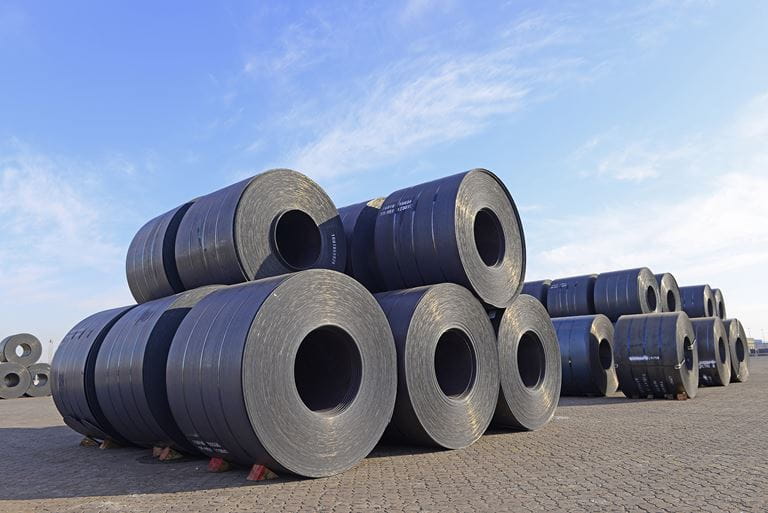
European domestic HRC market maintains downward trajectory; import prices aggressive
Hot-rolled coil prices in Europe continued to drift lower on Monday June 30 amid sluggish demand and ongoing pressure from imports.
Fastmarkets’ calculation of the daily steel HRC index domestic, exw Northern Europe was €557.67 ($653.36) per tonne on Monday, down from €565.63 per tonne on Friday June 27.
Deals for small and medium tonnages were reported to have been done within the wide range of €540-570 per tonne ex-works.
Unconfirmed sales of large tonnages were heard as low as €515-530 per tonne ex-works by several sources.
Compared with Northern Europe, business in the domestic market of Italy was minimal.
Sources said that mills in the country would accept €530-540 per tonne ex-works in the case of bookings, while last week this level was said to be possible for large volumes mainly.
Fastmarkets’ daily steel HRC index domestic, exw Italy was calculated at €535.00 per tonne on Monday, down from €540.42 per tonne on Friday.
The lower domestic prices were attributed to the fact that foreign suppliers, particularly from Indonesia are behaving very aggressively.
Information came to light about 30,000 tonnes of Indonesian coil being sold at €460 per tonne CFR Italy at the end of last week. This is when offers ranged €470-480 per tonne CFR.
India-origin material was available for customers in Italy at €520 per tonne CFR, while the most recent reports of offers from Turkey came at €500-520 per tonne CFR including duty, depending on the size of the cargo.
(The ninth paragraph of this report initially stated there were two cargoes of Indonesian coil sold. This has been corrected to reflect only one cargo reported.)

All ADI BFs at risk of closure
All blast furnaces (BFs) at flat steel producer Acciaierie d’Italia (ADI) could face closure in July, pending an anticipated ruling by the Italian authorities, Minister of Enterprise and Made in Italy, Adolfo Urso told trade unions on 27 June.
The statement came just one month after Urso outlined a two-step plan to relaunch ADI.
The Extraordinary Commissioners of ADI said that the schedule of the mill’s restart plan needs to be reviewed due to technical issues, the steelmaker said on 26 June.
“After years of complaints about the disastrous state of the plants and the failure to renew the environmental authorization, which expired two years ago and was subsequently extended, Minister Urso told us that without a new authorization and without a program agreement in July, the Milan court might decide to shut down ex-Ilva [currently known as ADI],” Italian trade unions UILM and UIL said in their joint statement dated 27 June.
The unions have called for a new industrial plan to resume ADI operations and to protect jobs.
“There is an issue we cannot ignore: there is a pending sentence of the Court of Milan which, if political decisions are not taken on the interinstitutional level, the environmental authorization issue will decide the fate of the plant,” the FIM-CISL trade union said. “The environmental authorization – which takes into account the environmental impacts – requires replacement [of BFs] with [direct-reduced iron] DRI modules fuelled by gas. To obtain this production cycle, it is essential to manage the gas supply through a [new] regasification hub in the port of Taranto.”
An Azerbaijani consortium led by Baku Steel – selected as the preferred bidder for ADI’s assets in March, and market sources said that the company was planning to use liquid gas to power the plant.
Issues with the restart of BF No. 2 has a major impact on the relaunch plans. When the furnace had to be stopped it was loaded with a large volume of pig iron and due to extreme temperature the BF could not be emptied at the time. The pig iron removal process started in December last year and ended in March 2025.
Due to complex works following the stoppage, additional technical issues at BF No. 2 remained unnoticed and which caused the initial emergency equipment shutdown. As the restart of the furnace could pose a threat to both workers’ safety and other operations at the mill, the decision was made not to resume operation at BF No. 2, while the mill made efforts to arrange a safe relaunch of the equipment.
In May this year, BF No. 1 had to be closed due to technical issues, and the restart timeline remains unclear, the mill said.
Local authorities seized BF No. 1 in early May following a fire and explosion at ADI.
ADI’s only operating furnace – BF No.4 was scheduled for relining that will take 2-3 months. The mill has four more furnaces which are currently not producing.